Preface
I
have been asked, by our
friends in Guernsey, to extend
my earlier book on H.M.S. Charybdis.
Having commissioned her and
was with her to the end, I
hope I can fill in some gaps
in her history. My efforts may
not be flawless, but I write
in memory of a grand ship's
company and in recognition of
the bond between Charybdis
and the people of Guernsey.
The following is a summary of
the ship named CHARYBDIS.
Chapter 1
- Early Days
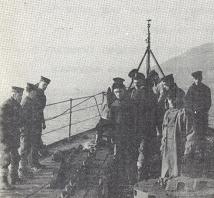
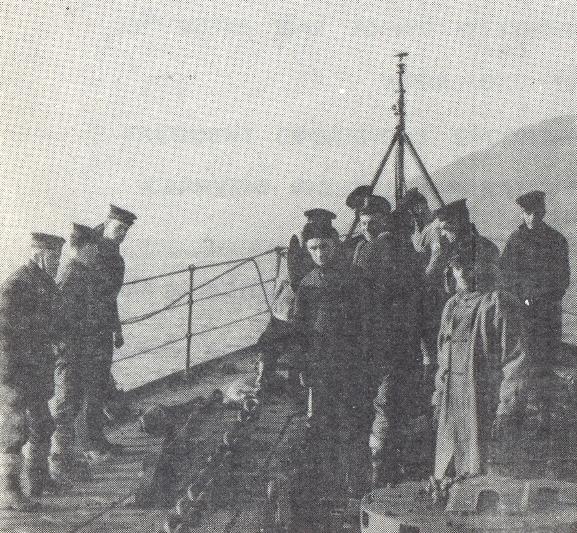
Cable
party preparing to slip anchor
.....
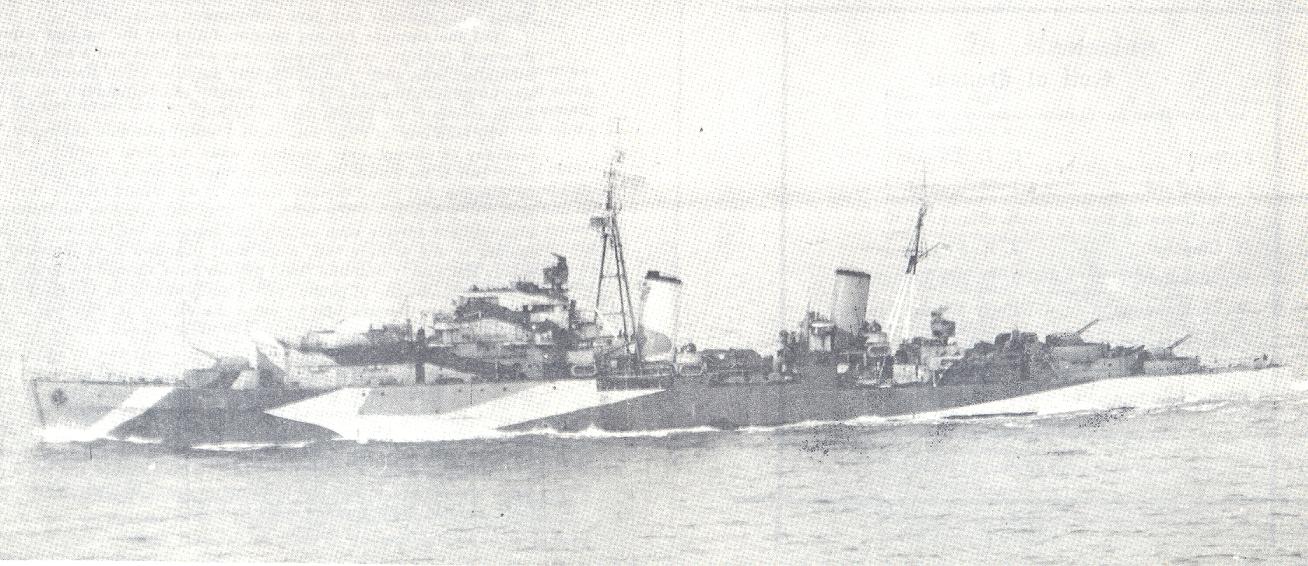
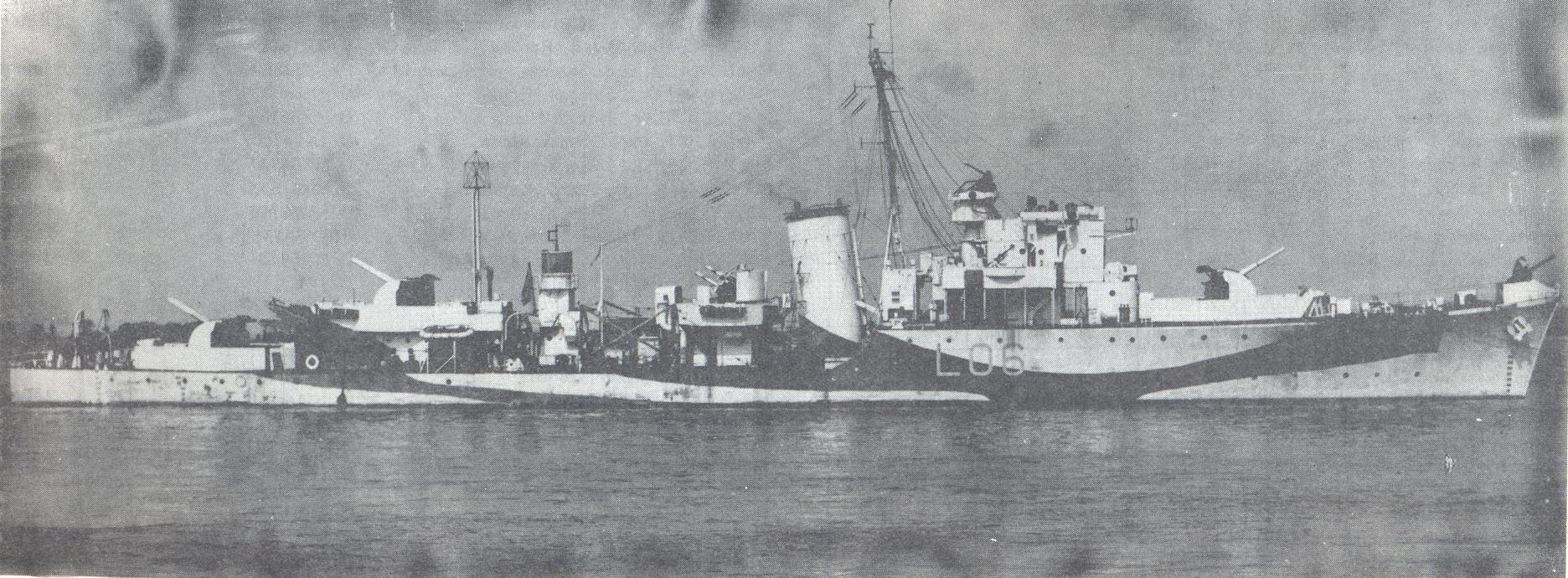
H.M.S.
Charybdis
primarily an anti-aircraft
cruiser, on the style of the
Dido class, commissioned at Cammell
Laird, Birkenhead on 15th
November, 1941. Her Captain
was Captain McIntosh whom I
was to meet again in later
years. From the very first day
of her commission the
Executive Commander, one John
Frances Whitfield, Royal Navy,
made it clear that Charybdis
was going to be a very
disciplined, if not hard ship.
I believe that in the first
six months we had a record
number of warrants read out.
The ship's company knew the
"articles" word by word.
Punishment was stiff, but at
least "keel hauling" had been
abolished.
Two
points of interest, Charybdis
carried in addition to her
Royal Marine Band, a Bagpipe
Band. This Pipe Band was
always in evidence at morning
physical training with the
Captain watching in approval.
Secondly, our ship's football
team which included a Bolton
Wanderers ex. pro.,
became champions of the Home
Fleet in March, 1942. No mean
feat with ships like the
Rodney (Flagship) and other
capital ships in competition.
The
day by day hum drum of her
"working up" period, prior to
her joining the Home Fleet at
Scapa
Flow, would make most
uninteresting reading except
the mention that she became,
by virtue of her latest type
radar, exceedingly rapid rate
of gunfire (16 round per
minute) and high speed, a very
efficient ship. An
efficiency that was to be a
saving grace to her in her
hectic times to come.
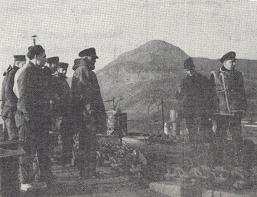
......
somewhere off the west coast
of Scotland 1941
So
it was, in her grey Home Fleet
colours, towards the end of
March, 1942 she sailed on her
first operation. This was as
main cover to mine-laying
operations at the Northern
Approaches. The work was done
swiftly and silently, and
although the enemy had
numerous surface forces
available, the mine laying was
successfully completed without
incident. It is difficult at
such an early stage of the Charybdis's
career to explain the close
comradeship of her ship's
company but it was evident to
me as on returning to base, Scapa
Flow, when in the Fleet
canteen some misguided crew
member of Rodney remarked
about the new light cruiser Charybdis
as the "Tiger without Teeth."
There was a spontaneous
reaction from the Charybdis
men, followed by a general
melee.
Repeated
exercises were carried out
inside the "Flow", which is
large enough to even allow the
firing - and recovery - of
torpedoes. These were still
the days of Fleets and it was
an impressive sight each
evening to watch, and listen
to the regulation “Sunset”
followed by a complete
black-out of the Fleet.
Then
in mid April, not that one
noticed the early Spring
in the Orkney's, it was side
parties to muster. After their
hurriedly painted work on the
ship's side we sailed,
completing upper deck and
superstructure in the colour
of our destination, en
route. The
colour
by which the enemy were to
call Charybdis
the "Blue Devil of the
Med.”. (Note: the
predominant colour of her
camouflage scheme.) On
the 18th April we joined the
Western Mediterranean Fleet
based at Gibraltar.
I
recall our first experience at
the Rock,
we were mainly classified as a
freelance cruiser. Lone
patrols were carried out
westward into the Atlantic, to
cover a south-bound convoy. On
the way back, make an attempt
to slip through the Straits -
in darkness - to test the
Garrison Regiment on the Rock.
On that occasion we were
straddled by 9 inch shells for
our troubles - full marks to
the Army. Then as the
situation deteriorated to the
East and Malta, Charybdis
was detailed to escort an
aircraft carrier carrying
fighter aircraft as far
eastward as was safe for the
carrier to fly them off, then
return to Gibraltar.
The
siege of Malta however
continued. The island was
already very short of
ammunition and fuel. Charybdis
continued with her calls of
duty. A search of the Atlantic
as far out as the Azores, for
an enemy surface raider. A
10 day fruitless search,
broken only by a short
refuel at the Azores.
Back to the Rock and surprise,
surprise, the harbour was full
- but our buoy in mid-stream
was still vacant. It was the
gathering of the Naval Forces
for the June vital convoy to
Malta.
There
were six supply ships, fast
merchant ships heavily laden
with the vital supplies the
Garrison of Malta needed. The
escort was strong – Malaya,
carriers Eagle and Argus, the
cruisers Kenya, Liverpool, Charybdis
and eight destroyers (close
escort) the anti-aircraft
cruiser Cairo, five large and
four small destroyers. (The
operation was given the code
name Harpoon and was commanded
by Vice Admiral A. T. B. Curteis
- flying his flag in the
Kenya.) The convoy slipped
through the Straits, in
darkness on 4th June, 1942.
Within hours the first "snooper"
enemy aircraft were on the
radar screen. But Fleet Air
Arm fighters kept a protective
screen around the Force.
Eventually the combined
attacks began, whilst our
fighters climbed to repel the
high level bombers, the three-engined
(twin torpedo) Italian
aircraft came in low over the
sea. All attacks were beaten
off, not without casualties
however, these were mainly
suffered by escort ships on
the outer screens. A destroyer
torpedoed and sunk, a heavy
cruiser damaged and had to
return to Gibraltar under
escort. A torpedo carrying
aircraft got through the heavy
barrage, and approached Charybdis
low on the starboard side. It
appeared to be making certain
of obtaining a hit, when a
single 20mm gunner got it in
his sights. The tracer and
high explosives shells went
directly into the centre of
the aircraft, which
immediately became a mass of
flames. Even so it dropped its
torpedoes, and these came in a
streak for the starboard bow
as the aircraft crashed into
the sea. I waited for the
torpedo to hit, but I was
amazed to see its track come
out on the port side. It had
passed directly underneath us.
Eventually
the Force and convoy reached
the approach to the Pantellaria
Straits. Here the carriers and
heavy units with their escorts
had to turn back. With no room
to manoeuvre, and the enemy on
both sides of the Narrows,
disaster would be certain. So
the A.A. cruiser Cairo along
with nine destroyers, four
minesweepers and six
minesweeping motor launches
took over the task of getting
the remnants of the convoy to
Malta. This depleted Force was
heavily attacked by two
Italian cruisers and its
escort of destroyers, Stuka
dive bombers, German bombers
and Italian torpedo bombers.
Despite
all the might of the enemy two
of the merchantmen were
escorted into Malta. The
supply ships were a relief to
the starving Garrison, but
only temporary. The enemy
started round the clock
bombing and strafing. It
appeared that Malta must
succumb. British submarines
made the arduous voyage from
Gibraltar to Malta carrying
essential medical supplies and
even cans of high octane fuel.
The two ultra fast minelayers
H.M.S. Welshman and Manxman,
both made lone supply runs.
Relying entirely on their high
speed they delivered food and
ammunition, etc., with the odd
bag of mail filling in any
vacant space on the upperdeck.
They were spotted and attacked
on every one of their
journeys, but their high
speed, excellent seamanship
and using darkness of night to
go through the Narrows, they
both achieved the object of
getting more supplies through.
Something
had to be done and so
operation ''Pedestal'' was
planned and the "O.H.M.S. or
All in a Days Work" details
more of this ship called
CHARYBDIS.
Chapter 2
– Operation Pedestal
(Note:
there a numerous
detailed accounts of
this massive, and
ultimately successful
convoy operation.
Readers are invited to
start with a
Summary
by Arnold Hague)
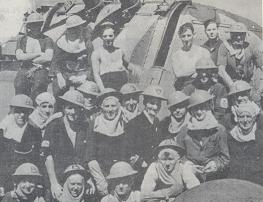
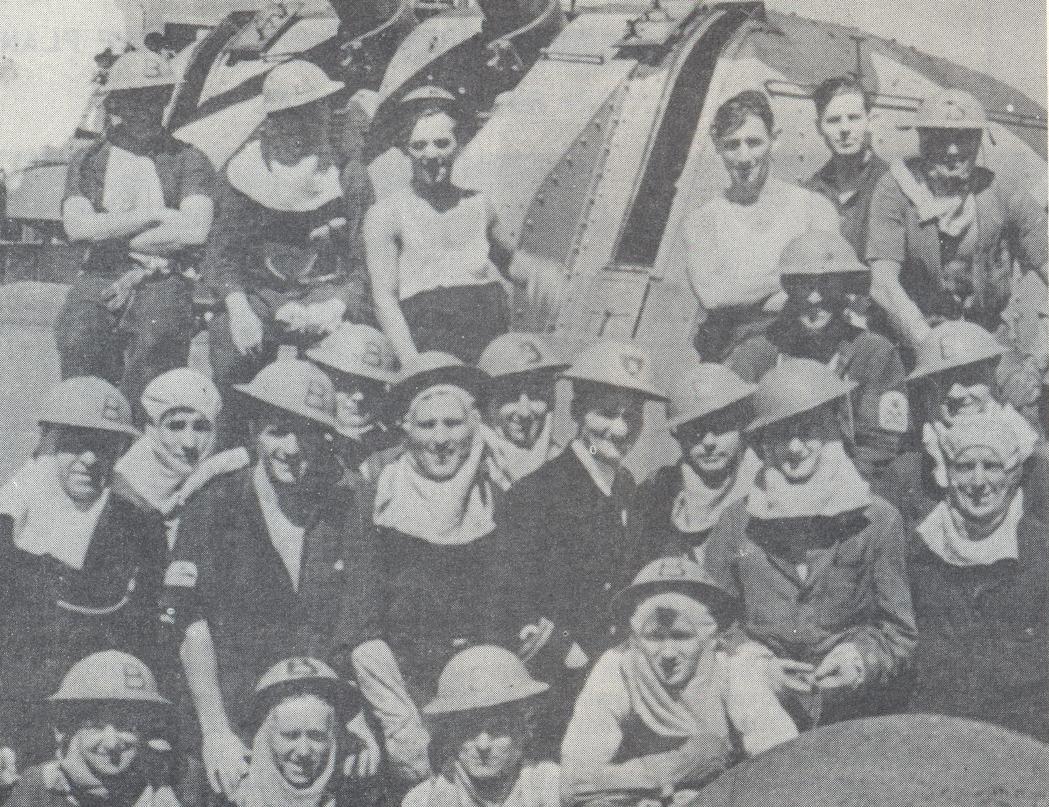
'B'
guns crew of Charybdis during
a lull
The
epic convoy, with its sea and
air battles, to Malta in June
1942, was over. Temporary
relief had been given in the
form of the two supply ships
being safely escorted into
Grande Harbour for the loss of
three destroyers and four
supply ships of the convoy.
H.M.S.
Charybdis,
a light anti-aircraft cruiser
based at Gibraltar, resumed
her normal role of "any task -
anywhere." The next few weeks
saw her escorting in turn such
ships as the aircraft carriers
Argus, Furious and the U.S.S.
Wasp in the ferrying of
fighter aircraft to Malta.
These carriers could only be
escorted as far as the Sicillian
Narrows, then
the fighters took off for
Malta. Enemy aircraft
opposition was always very
strong, with their bases only
ten minutes flying time away.
Indeed, many ferried aircraft
were shot down on route.
Returning
to Gibraltar after one such
operation, the normal routine
of fuelling, re-ammunitioning,
stores, etc. was interrupted
by an ever growing number of
warships. Destroyer
pens, cruiser buoys
and battleship/aircraft
carrier wall berths became
fully occupied. Rumours spread
around below decks. There was
one thing that was certain,
the gathering of the Fleet was
not there for any social
occasion.
On
the dark moonless night of
10th August, 1942 the Western
Mediterranean Fleet slipped
out of Gibraltar to join up
with the Home Fleet which had
come from the Scapa
Flow. The meeting did not go
unnoticed, and the Spanish
fishing boats duly made their
reports. At the following
dawn, after a night spent
decoding and answering light
signals, the Charybdis
found herself in very great
company. It was the largest
and most powerful Naval
force ever gathered in the
Mediterranean. Capital ships
included the battleships
Rodney and Nelson (16" guns),
aircraft carriers Indomitable,
Illustrious, Victorious, Argus
and Eagle. Cruisers
Sirius,
Phoebe, Charybdis,
Nigeria, Kenya, Manchester,
Cairo and 28 destroyers.
This powerful force with the
destroyers way out on the
beam, was ringed round a group
of 14 merchant ships which
were about to embark on
operation “Pedestal." History
was to be made by these
merchant ships, ships like the
tanker Ohio and the ships
loaded with aviation petrol,
ammunition and food, which
went through hell itself.
Steady
progress was made eastward,
and the objective Malta. Each
aircraft carrier her trailing
cruiser astern of her. It was
the trailing cruisers task to
give extra anti-aircraft fire
in the event of dive bombing
or low level air torpedo
attacks. Charybdis
was ordered to trail the
carrier Eagle for the whole
operation.
At
1408 hours on the 13th August
the enemy struck, Charybdis
resounded to 4 dull heavy
explosions. Eagle had been hit
by 4 torpedoes (Note:
fired by U.73) along her
port side. With the wheel hard
astarboard
Charybdis
avoided the Eagle who was
already rolling over to port
and sinking rapidly. The Eagle
had gone in 5 minutes, taking
with her over 800 men. But
amongst those saved was her
new Captain, our old Captain
McIntosh. (I
was later to serve with him
again on commissioning the
carrier Implacable in 1944.)
The
whole Fleet took evasive
action, and with warning
blasts of S - S from Charybdis,
the Victorious dodged two
torpedo attacks. Clear of the
sunken Eagle's position the Charybdis
put out her depth charge
patterns, but it was destroyer
Imperial who saw the U boat
surface dead ahead of her. A
single shot went straight
through the conning tower, and
the destroyer went on to ram.
On impact the destroyer sank
the U boat in a giant V. (Note:
Imperial was lost in May
1941. This incident refers
to the sinking of the
Italian Cobalto
by destroyer Ithuriel
later in the afternoon.)
The
battle was on - that night and
the following day saw further
submarine attacks on all
sides. Enemy air activity was
increasing but the fighter
curtain put up by the Fleet
Air Arm, broke up each
successive attack. It was fast
approaching a crucial point of
the whole convoy operation. The
arrival at the Pantelleria
Straits between Sicily and
the North African coast.
This
narrow sea passage was
entirely dominated by the
enemy, and it would be suicide
for any large capital ship to
attempt to force its way
through. Accordingly the Fleet
turned back westward and a
selected escort was chosen for
this final gigantic hurdle.
Rear Admiral Burrows a very
experienced tactician in the
Mediterranean Theatre of War,
was to be in command of this
small fast final escort. As
fate would have it, his
Flagship the heavy cruiser
Nigeria had been damaged by an
aerial torpedo so he
transferred his flag to the
destroyer Ashanti. At almost
the very moment that the Fleet
was to leave Force “H", so did
the enemies main air attack
commence. For the last two
hours groups of enemy aircraft
had been forming up on the
radar screens. Carrier based
fighters had been directed to
engage and break them up. But
the enemy bases at Sicily were
only minutes flying time away,
so fresh relays of bombers and
torpedo planes kept circling,
looking for an opportunity to
strike. The ships gunners had
to be constantly alert, now
and again two or three of the
enemy would break through, but
in the main they were forced
to drop their torpedoes out of
range. The enemy tactics were
wearing the men down, and
indeed the British pilots were
becoming exhausted.
Accordingly
with darkness now almost upon
us, the fighters started
landing on. At 1975 I saw the
last fighter land on
Victorious, then
in the faint night sky I saw a
group of black dots 1500 ft.
overhead. They started to peel
off, one after the other, in
vertical dives, I realised
they were J.U. 87's (Stuk8S)
and they were diving on the
carrier Indomitable. Though Charybdis
was too far away from the
Indomitable for our close
range fire to be effective, I
opened fire with the single
port Pom
Pom,
hoping the tracer would warn
Indomitable and her closer
escorts. Heavy A.A. fire
started at once but these Stukas
were the Luftwaffe's special
anti-ship dive bombers.
Indomitable received three
direct hits, and several near
misses.
Charydbis
steamed over to her at high
speed, and as we approached
she appeared to be on fire
from stem to stern. Smoke was
billowing out of her hangar
lifts and what I thought was
the flight deck, dripping
molten metal. (This was
actually blazing aviation
fuel.) The Indomitable was
temporarily out of control,
and Charybdis
circled her ready to go
alongside if need be. It
appeared that the Fleet had
been caught out by the Stukas
attack, but what was really
happening was that the enemy
was throwing everything they
had, and could at the Fleet.
Some 145 enemy planes, high
level bombers, dive bombers
and torpedo planes made low
level attacks. There were two
more casualties immediately.
The destroyer Foresight was
torpedoed and sank, and the
merchant ship S.S. Deucalion
was severely damaged by bombs,
lay stopped, and the destroyer
Bramham
was left to stand by her. Both
the Rodney and Nelson had near
misses, and the Victorious was
hit by an anti personnel bomb
on her flight deck. All ships
were twisting and turning,
whilst Charybdis
blasted away at every radar
contact approaching the
Indomitable.
Admiral
Syfret
in charge of the main force
was trying to organise some
sort of fighter cover for the
departing force “H” and the
convoy, as well as giving
extra cover to Indomitable,
whose loss would be a tragic
blow. But with the loss of
Eagle, Victorious unable to
fly off and Argus not suitable
for blackout take offs, no air
cover could be given. A signal
from Bramham
said S.S. Deucalion
had been hit by a torpedo and
blown up. It was not all one
way, 9 enemy planes were shot
down in this mass attack. To
the east force “H" was
approaching the Narrows, where
Rear Admiral Burroughs had
been told, lay
several U boats in waiting.
Though
it was now almost completely
dark, a group of 24 enemy
aircraft made a dive bombing
attack on the convoy. The
tanker Ohio was hit and set on
fire. S.S. Empire Hope
carrying canned aviation fuel
was hit by three bombs and was
soon blazing furiously. S.S.
Clan Ferguson, struck by a
stick of bombs blew up with a
horrific roar. The S.S.
Brisbane Star illuminated by
the flames of sinking ships
was desperately making maximum
speed, and rapid alterations
to course, but two bombs
struck her and she also lay
stopped, badly damaged. The
convoy was in real trouble
now, scattered by the vicious
air attack, depleted by the
withdrawal of Nigeria (and her
screen of three destroyers)
and with only the Kenya,
Manchester and Cairo in close
proximity, they were going to
be easy prey for the U boats
and E boat flotillas. Several
destroyers were scattered,
some standing by disabled
ships, others attempting to
get the surviving ships
together again. Suddenly the crusier
Cairo was hit by two or three
torpedoes and quickly sank.
This further depleted force
“H" and Burroughs signalled
Admiral Syfret
that his force was drastically
reduced. In consequence Syfret
signalled Charybdis
with her two destroyers, who
had been covering the gap
between both forces, to join
the convoy. Burroughs
indicated that Charybdis's
support was most urgent, and
that she should make every
effort to rejoin the convoy in
the shortest time possible.
This signal was followed by a
report that the cruiser
Manchester had been torpedoed
and sunk.
Captain
Voelcker,
of the Charybdis,
knew that time was against
him. He signalled his
destroyer that in his effort
to rejoin the convoy before it
was eliminated, he intended to
take the shortest route -
through a known enemy
minefield. His decision was
further endorsed when he heard
the cruiser Kenya report being
torpedoed in the bows. Charybdis's
luck held, and soon she was
passing the destroyer
Pathfinder who was searching
for Manchester survivors.
Within
minutes of Charybdis
rejoining the convoy her radar
showed surface craft
approaching at a rate of 40
knots. She warned all ships
and commenced her anti E boat
tactics. These defensive
tactics consisted of firing
broadside after broadside at
the approaching enemy, in a
creeping barrage, plus rapid
alteration of course. In this
way she could comb the
approaching torpedoes, in the
small amount of area to
manoeuvre and by pre-fusing
her shells, drive off the E
boats. Altogether 8 Italian
and 2 German E boats delivered
fifteen attacks and although
several were damaged none were
lost.
Now
the Admiral had only the
cruisers Charybdis
and Kenya (which had a damaged
bow) and a force of seven
destroyers, to meet the
Italian fleet, whose force of
six cruisers and 11 destroyers
had been reported steaming to
intercept the convoy and was
expected to engage at dawn.
The four remaining urgently
needed supply ships had to be
got to Malta. Soon another
action may be embarked on but
let us pause here and remember
the men on those supply ships.
They had seen other comrades
on floating bombs disappear in
columns of flame and smoke.
But still they kept to course
following the escorts as if
Fleet trained.
Aboard
the flagship Admiral Burrough's
face was grey and drawn with sleeplessness,
he knew that the testing time
of his life was probably at
hand. Soon he might have to
order 2,000 men to action with
the Italian fleet and most of
them would die. He would
almost certainly die with
them.
Worse
still his mission would end in
failure. After the warships
had made their fruitless
suicidal attack, and after
they had been beaten into
blazing wrecks the enemy would
sail in and finish off the
remaining merchantmen of the
convoy. Malta would starve and
fall to the enemy and he knew
what that might mean - at the
best victory longer delayed,
at the worst defeat.
Dawn
came and the convoy was
grouped in a diamond
formation. At the head of the
diamond was Rear Admiral Burrough's
on Ashanti, the four
merchantmen in the centre, Charybdis
on the port beam and Kenya on
the starboard and the
remaining destroyers made a
screen on each quarter.
Burroughs
signalled all units "engage
the enemy on first sight,
drive off at all costs, and
God Speed." Everyone was
looking on the horizon for
tell-tale smoke or signs of
the enemy masts. Aboard Charybdis
the men were weary but they
knew Malta was not far ahead.
There were no air or submarine
alarms now and somehow
it
seemed
like a lull before the final
storm.
The
lull was used to empty the
toilet buckets, feed off the
corned beef sandwiches, and
drink the lukewarm water. She
had been extremely lucky - the
Germans were later to call her
the Blue Devil - her
casualties were from shrapnel
and near bomb misses, but in
the main from fatigue.
Indeed,
fatigue was the hazard aboard
every ship in the convoy. If
the Italian task force
intercepted the convoy, their
superior fire power and
numbers would completely
destroy it. Admiral Burroughs
decided that the best defence
would be to attack. As Charybdis
was the only cruiser capable
of high speed she was ordered
to the van, have all torpedo
tubes ready, and ready use
shells fused at maximum range.
She would steam directly at
the enemy hoping to get some
salvoes in before the enemy’s
8" guns pounded her.
The
Kenya was to make her best
speed - about 15 knots -
approaching from the south
east, opening fire when in
sight, and irrespective of
being out of range. The
attempt here, to split up the
enemy force, hoping two
destroyers could get in a
torpedo attack. The remaining
destroyers were to make smoke
to cover the convoy, and
whilst the supply ships turned
away south, turn from the
smoke screen and join in the
attack. The situation looked
bleak.
Still
there was no sign of the
expected Italian fleet perhaps
there was hope yet. Somehow
the Italians had failed to
rendezvous with their kill.
Aboard the Italian flagship a
certain amount of confusion
was taking place. Mussolini
had instructed his Fleet never
to engage the enemy unless it
had air cover, fighter
protection. He had asked Kesselring
for fighter power, hut Hitler
was furious with the Italians
for their failure to destroy
completely the June Malta
convoy. So Kesselring
replied that the German
fighters were engaged as cover
for the German bombers. Indeed
the Luftwaffe had found the
convoy again. and
every effort was made to beat
off the attack. The Ohio had
now to be towed along by 2
destroyers, one each side of
her.
Meanwhile,
two R.A.F. Wellingtons had
located the Italian Force
dropping flares and bombs over
the fleet then, in plain
language, to send a signal
directing imaginary aircraft
to the scene. Several signals
were sent and these were
picked up by the Italians and
they decided, as they had been
denied air cover, that they
must abandon the attack on the
convoy. With less than an
hour's steaming from the
convoy the Italian Force
turned back to the north and
headed for base.
From
the very first report to the
British that the Italian fleet
had put to sea, our submarines
had been alerted. It was,
then, the submarine “Unbroken”
who lay in the path of the
returning Italian force. She
made a successful attack and
two heavy Italian cruisers
were sunk (Note: one heavy
and one light cruiser were
damaged). Other attacks
were made, and though no
sinking were
claimed, several Italian units
had severe damage.
So
for Force ''A” and the convoy
remnants, Malta came in sight.
The impossible had been done.
As the merchant ships entered
Grand Harbour to a tremendous
reception, Force ''H” wheeled
hard astarboard
and with a final farewell
signal, set course to cover
Ohio. But now Ohio had reached
a point where Malta based
fighters could protect her,
and she safely entered port.
Her Captain, Captain Mason was
awarded the George Medal. (Note
– George Cross.)
Steaming
westward Force ''H” could only
make 14 knots, the maximum
speed of the torpedoed Kenya.
The return journey to
Gibraltar was to be going back
through the hell of the
previous 2 days, with the
vital factor of reaching the
Narrows by nightfall. In
addition, the whole Force
consisted of men who had had
no sleep for three days and
two nights. The time was 0849
hours,
Malta was out of sight now
astern, and the sun beginning
to rise in a clear sky. On
board Charybdis
the order was "Stand to," she
had picked up aircraft on her
radar. The report "Boggies
on the screen" went out to the
accompanying ships, the
Luftwaffe had taken over from
the Italians. Charybdis
monitored the approaching
enemy aircraft, passing on
their formations and speeds,
to the remainder of the Force.
At
0905 hours the first of the
attackers came in. They were
JU 88's, twin engined
and carrying 1000 lb bombs.
They came in shallow dives,
out of the rising sun, three
or four planes attacking each
ship of the Force. As each
attack was beaten off, a fresh
wave came in. Standing on the
open bridge of Charybdis,
Captain Voelcker
himself gave orders down the
voice-pipe to the helmsman. He
would wait until he actually
saw the bombs leave the enemy
aircraft, before ordering hard
aport
or hard astarboard.
Twisting and turning Charybdis
was straddled, blasted by near
misses, and spattered with
bomb splinters. All the time
she kept up a terrific barrage
of fire, but as the attackers
were constantly diving out of
the sun from astern, the
forward guns could only engage
when the ship was on the turn.
Each ship of the Force was
similarly bombed, but
miraculously none received a
direct hit.
Attack
after attack came in, hour
after hour. Now a new threat,
ammunition was running low for
the aft guns manned by Royal
Marines, and their gun barrels
were almost glowing. Still the
enemy came in, diving more
steeply now as the sun climbed
higher in the clear sky.
Volunteers made up a supply
party, and carried shells from
the forward magazines to the
aft guns. For 8 hours the
enemy dive bombed Force ''H'',
with never more than a few
minutes between each wave of
aircraft. The ship's Padre
moved around the ship ignoring
the flash of guns, and blast
of bombs. An encouraging word
here, a bar of “Nutty" there,
his appearance - minus even
steel helmet - gave heart,
especially to the younger of
the ships company, and Charybdis
had boys of 17 in her guns
crews.
It
seemed that something had to
give. The situation aboard Charybdis
was getting desperate. and
no doubt the same aboard the
Kenya and the destroyers.
Either a bomb was going to
find it's
target, perhaps the guns
become overheated, or the men
collapse from exhaustion.
There was a possibility that
the main armament would run
out of ammunition. Despite the
fact that some 8 or 9 enemy
aircraft had been shot down,
the attacks were being pressed
home. The time was now 1720
hours, nearly 9 hours of
concentrated bombing. Ships
twisting and turning,
crossing each other's bows,
but defiantly remaining an
organised Force.
There had been casualties but
not one ship of Force "H" had
been hit. The clear blue sky
had held the bright sun all
day, and the enemy’s attacks
had become steeper with the
rising sun. It was then that
the unexpected thing happened.
A large black cloud came
slowly over the sun and stayed
there. Now the close range
gunners could quite clearly
see the diving enemy. They had
new heart and the barrage of
tracer and H.E. increased,
with aircraft falling in
flames. Suddenly the attacks
stopped and the radar screens
were clear.
Re-grouping
Force “H" with Ashanti at it's
head, steamed into the Narrows
as darkness fell. Every nerve
was strained, radar and asdics
sweeping constantly, for this
was the ultimate of enemy
traps - where only two days
previously the cruisers
Manchester and Cairo had sank,
with part of the convoy. Tense
and silently the ships slid
through, perhaps their 14
knots maximum speed helping in
their approach. The Kelibre
Light still swept the sea, to
the chagrin of the watchful
men. We knew that the Narrows
had been mined as the convoy
was taken through, and that it
would not have been swept
clear since. Also many new
types of weapons had been
used, such as the aerial
torpedo, which having failed
to hit a target then became a
mine. Charybdis
streamed her Paravanes,
and put her faith in God.
It
was with very heavy lidded
eyes that the lookouts and
bridge crew on Charybdis,
saw the faint light of dawn
astern. Suddenly the orders
"Stand to - Aircraft dead
ahead - Prepare to repel
aircraft." Just as quickly
rang the "Cease fire" bells.
The approaching aircraft
flying low over the sea,
waggled its wings, then
flew directly down the centre
of Force "H". Its pilot and
navigator waving like maniacs.
They were the first friendly
aircraft we had seen in four
days. The fact that they flew
such an antique plane as a Swordfish,
probably saved them from being
shot down.
"FORCE
H HAD REJOINED THE FLEET."
Next
came
the Bos'ns
Pipe, "the Captain will speak
in 5 minutes time." Captain Voelcker
then came on the ships tannoy,
saying we had rejoined the
Fleet - this for the men below
decks - and that before the
ship "Stood down," he had
asked the ship's Padre to say
a few words. I saw men slowly
slumping by their gun
positions, weariness and
re-action setting in but when
the Padre spoke, they joined
in - "Our Father Who Art in
Heaven."
More
Fleet aircraft joined the
welcome reunion, then
the whole Mediterranean Fleet
surrounded Force "H", and
under blue skies reached
Gibraltar. On arrival at Algerzerias
Bay, the Fleet slowly circled
whilst Force “H" entered
harbour, in naval traditions
an honour indeed.
The
following day was spent in
re-fuelling, re-ammunitioning
and preparing the dead for
burial at sea. Within 48 hours
Charybdis
was at sea again, as escort to
the carrier Furious, ferrying
fighters to Malta. the
journey to the Narrows and
back, was uneventful. Perhaps
the enemy were counting their
losses. Or debating how 2
cruisers - one badly damaged -
and 5 destroyers had managed
to get 4 supply ships to
Malta, past the combined Axis
forces.
Back
at Gibraltar again the Charybdis
had the first of her gun
barrel changes, the original
barrels completely worn out.
Some minor patching up was
done whilst "VOLUNTEERS" were
ordered to unload an
ammunition ship out in the bay
- as it was considered too
dangerous by the dockyard
workers to unload in harbour.
3
Chapter
3 - Convoys and Bay of
Biscay Patrols
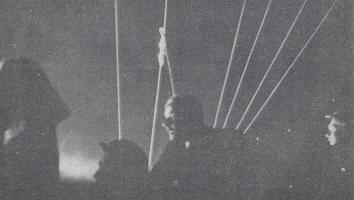
Night
Action - 'Charybdis' bridge
personnel silhouetted against
'B' guns flash
So
then it was back to sea with Charybdis
slipping her buoy, and being a
"loner" steaming at 25 knots
back into the Atlantic. There
was a south bound convoy to
cover and part
of her duties were to
monitor the area around the
Brest Peninsular. The U boats
sailed from Brest, and were
often guided to convoys by
long range Focke-Wulf
aircraft. So when Charybdis
picked up a snooper
on radar, it knew that U boats
were in the vicinity. In point
of fact on this operation
there did appear on the
horizon an enemy four engined
F/W long range aircraft. It
shadowed Charybdis
for about 4 hours and at no
time dare it be risked losing
sight of. If there was any
cloud about then extra caution
was needed, because under
cover of a cloud the enemy
could, and did, swoop in a
surprise attack. After
a period of circling around
the enemy would be replaced
by a refuelled aircraft, and
so it went on. The
convoy was handed over to
South Atlantic forces, and Charybdis
was back at Gibraltar.
This
started a period of Bay of
Biscay patrols. Monotonous in
the extreme, these patrols
were always carried out alone.
The “Bay" is notorious for it's
storms of course, but it was
when the weather was foul that
Charybdis
was safest. Bad weather meant
that "snooping” enemy aircraft
was not about, and the 'U'
boats could not get a
periscope sighting. As
long as 8 to 9 days at a
time were spent on these
patrols, sometimes with a
little drama thrown in.
On one such patrol the sea was
like glass, with a clear blue
sky. Dangerous conditions and
Charybdis
took to a zig
zag
course, and an increase in
speed. Sure enough the radar
picked up an approaching
aircraft. When it came in
sight over the horizon and in
answer to the challenge, fired
two "Very" flares, we closed
up at action stations -
because the flares were the
wrong colour. The enemy
circled for a while, then
decided he had bluffed us.
Still cautious though,
remaining at just about our
maximum range. Eventually he
came that little bit closer,
and we sent off four salvoes.
As soon he saw the flashes he
went into a dive, and our
shells burst exactly where he
would have been. He now knew
that he had been identified,
kept out of range and no doubt
was sending out signals to 'U'
boats in proximity.
We
now had a second radar echo.
This aircraft came in sight
and was immediately recognised
as a Sunderland Flying Boat.
By Aldis
Lamp we put the Sunderland in
the picture. She flew away
until she was almost off the
radar screen, then turned back
to catch the enemy unawares
from astern. To our delight we
saw the enemy aircraft go down
in flames. Such little
co-ordinated successes
brightened the weary routine.
Our
allocated patrol time
completed, we would return to
the Rock. The sight of which
was now becoming a bit of a sickener.
Whilst re-fuelling went on,
fresh stores were loaded,
ammunition topped up, and
selected parties sent ashore
to work inside the Rock.
Gunners went to a special
''Dome'' training, there was
always a
certain bitterness
about this, and the Officer's
in charge knew it. After days
and days of the real thing, to
see it on a screen was as bad
as being told they were not
doing their job properly. So
these ''Dome'' visits were
made as brief as possible, and
a brisk walk around the town
substituted. One could have a
complete change, not by
choice, in becoming a member
of the "selected party" for
working inside the tunnels of
the Rock. Here the Charybdis
men worked knee deep in water,
hauling 3in electric cables
along for the R.E.'s.
This was not a punishment for
no offences had been committed
rather, I think, it was an
incentive to make men glad to
get back to sea.
Chapter
4 - Operation Torch, French
North African Landings
Having
done three days working
inside the Rock, whilst
others painted ship, cleaned
out the bilges, and all the
work that goes into running
a man o' war. It was
noticed that the harbour was
starting to fill up again. More
destroyers
and cruisers, oilers
and submarines. Another
Malta convoy? Mess
deck “buzzes" were very strong
in that belief. On the evening
when it seemed that not
another single ship could find
a billet in the harbour, a
conference of all ships
Captains was held in the Wardroom
on board Charybdis.
This closed at 2300 hours. I
was “Key Board Sentry" for the
middle watch, a duty normally
reserved for the R.M.'s
(perhaps they had all been 'at
the Conference,) to this day I
do not know why I had that
particular duty. I remark on
this because I was able to see
the number of high ranking
officers, and sense the
general tension.
When
we sailed the following night,
again selected because there
was no moon, we were told our
objective - the North African
landings. Whilst the Americans
were to take Casablanca, the
British had to take the
Mediterranean ports, with Charybdis
covering the toughest of them
all, Algiers. Charybdis
circled her flock of
troopships, getting them in
line and order of approach.
That done and an order for
complete radio silence, with
all ships blacked out, she
positioned her allocation of
destroyers on the beams. Much
depended on the element of
surprise. If undetected,
Algiers and its valuable
harbour could be taken,
without too much fighting. If
we were observed, then a
destroyer with Commando's
aboard was to be sent in at
high speed - burst through the
boom defence - and ram the
main jetty, bows on. The sea
was moderate, not unsuitable
for Infantry Landing Craft,
and Charybdis
leading the Algiers expedition
closed in on the harbour
entrance. This entrance had
heavy artillery batteries on
each side, capable of giving a
covering cross fire. As the
Force silently, and now at
about 8 knots crept towards
the entrance, the lights of
vehicles moving along the
waterfront - and the town
itself well lit up - reminded
me that it was the first port
I had seen with lights on for
a long time.
Suddenly
portside of the boom a light
was flashing a challenge. The
game was up, there was no
point in Charybdis
attempting a bluff reply from
a blacked out ship.
Accordingly rapid fire was
opened up on the harbour
batteries, whilst the
destroyer increased speed to
ram through the boom. As she
smashed her way through, we
saw the lights of Algiers
going out fast. The batteries
were soon silenced, and the
destroyer having rammed the
waterfront, had landed her
Commando's. Fighting continued
throughout the night, but at
dawn Algiers had been taken. Charybdis
now escorted the empty
troopships westward passing
them over to destroyers in the
Straits, and putting into
Gibraltar herself. Here she
quickly re-fuelled, took on
all the new Allied currency
some millions of £'s worth -
in notes to be the official
money in North Africa, in
place of the franc, German
mark and Italian lire. Re-ammunitioning
was completed in record time,
and Charybdis
returned to Algiers at high
speed.
We
went alongside the battered
jetty at Algiers, and off
loaded the new currency. There
was still some resistance
around, and sniping was taking
place from roof tops. I recall
a group of war weary 8th Army
men winkling out these
snipers, putting their heads
into our mess deck portholes
and asking if we had anything
for them to eat. We had a
stack of “Herrings in", which
somehow had not found their
usual destination - over the
side - and these the 8th Army
men seized with delight. We
all agreed that they must
have, indeed, been hungry.
On
leaving Algiers we were
ordered to proceed east, and
give support to the attack on
Bizerte.
There we found monitor H.M.S.
Roberts (15in guns) well in
shore, and blasting her shells
inland. About 1600 hours our
radar detected a very high
flying aircraft, a "reccie"
plane, always
an obvious sign of
imminent danger. Sure enough,
at dusk in they came. Spread
out, low over the water, came
some 20 to 25 enemy torpedo
planes. Charybdis
immediately increased speed
and twisting and turning, went
to meet the enemy formations.
She opened fire as soon as
effective range was reached.
At least 6 torpedoes were
dropped at her, whilst the
other aircraft tried to get
round to the Roberts. The
Roberts seeing she was about
to be attacked, sent an urgent
signal to Charybdis,
pointing this fact out. There
was a temptation on the bridge
of Charybdis
to signal back "we are not
having a tea party either,"
but as it so happened
the Roberts was safe. Being
designed and built as a
Monitor she had a very shallow
draft, to enable her to get
close inshore to bombard.
Normal set running torpedoes
could not hit her and, in
fact, none did.
Eventually,
after some routine work along
the North African coast, which
included covering a large
convoy of troops
ships, in company with four
other Dido class cruisers,
forming the 10th Cruiser
Squadron under Rear Admiral Vian.
A word
here on Rear Admiral Vian,
of the the
Cossack fame. He was
flying his flag Euryalus,
and with a touch of his “the
Navy's here" he signalled the
Squadron to "Line ahead."
Steaming at full speed we
swept straight down the centre
of the troop ships, it must
have been a re-assuring and
impressive sight for the
troops. Well, eventually the Charybdis
did the inevitable, she
returned to Gibraltar. If
Gibraltar had been a grim
place before, it was even
worse now. With the surge of
more Navy ships, and Americans
included, the place was "dry"
with the prices of everything
trebled. However, this time
the Charybdis
men were not required to
"volunteer" for work inside
the Rock. Re-fuelling etc.
completed, we were wondering
what was next on the agenda
when a boat came alongside -
loaded with mail, from the
U.K. This was loaded with
glee, and unrealised energy.
Next, as an infantry landing
craft came alongside loaded
with enemy P.O.W.'s
Commander Whitfield, Royal
Navy - our Commander announced
over the tannoy
that there "must be no
fraternizing with the
prisoners." That announcement
created the biggest roar of
the whole day, aboard. The
enemy P.O.W.'s
were blind-folded as they came
aboard for security reasons,
and consisted of Italian Naval
personnel, and air crews of
the Luftwaffe. They were
escorted and that is the only
word to describe it - up the
companion way - to the ship's
company ''Rec
Space." Here our Royal Marines
took up guard duties.
Chapter
5 - Atlantic, Home Waters,
Russia?
So
we slipped our buoy joyfully,
and as darkness fell steamed
alone out into the Atlantic.
It did occur to me that, if on
this trip we should be
attacked in anyway, then our
enemy’s comrades would share
the pleasure. Our course was
set to cover a north bound
convoy of ships, in ballast,
and so for the first day we
steamed W/Nor/West. For the
time of year the seas were
relatively moderate. As usual
Charybdis
did her "daily orders," clean
flats, heads, mess decks, the
Royal marine barracks area,
the galley, the sick bay -
very few de-faulters
- but a queue of "Request men"
- all with their own ideas of
hopeful extensions of leave. A
warship of the Royal Navy has
a regular standing party
throughout it's
commission, and it was these
men who were requesting long
overdue leave. De-faulters
dealt with, the
"Requestmen"
were told each case would be
dealt with on it's merit, on
arrival at U.K. There were
some unhappy faces, however,
at the start of this steaming.
The men of
all ranks, who were still
under stoppage of leave.
Here again the Captain
endeared himself to the ship's
company by having the Bosun's
Mate pipe over the tannoy
“the Captain will speak in 5
minutes time." When Captain Voelcker
did speak it was with his
usual calm voice, to say that
all men under stoppage of
leave from Mers-el-Kebir,
could consider it cancelled. I
would like to think he heard
the roar of applause.
Steaming
through the early hours of the
night, we found the wind
rising rapidly. By the morning
watch it was blowing a Force
9. As we were now heading
north into the Bay of Biscay,
all normal storm routine was
put into being. Nobody was
allowed on the upperdeck,
any movement from for'ard
to aft, or vice versa was via
below decks, with the
immediate closing of
watertight doors en route. By
the forenoon it was blowing
Force 10 and although the
ship's engines were doing
revolutions equal to 15 knots,
the ship was just keeping her
head into the seas. She was
doing some very uncomfortable
"pitching," burying her bows
deep, then rising high only to
plunge again. The routine of
the ship was carried on more
or less as normal except for
the galley where, of course,
restrictions in the use of
boiling water and other hot
liquids had to be taken, in
view of the motion of the
ship. But the P.O.W.'s
found life aboard a Royal Navy
cruiser distinctly
uncomfortable. The Germans
were very ill, as were the
Italians, but in typical
Teutonic fashion, the Germans
ordered the Italians to attend
to them. We left them all to
get on with it.
As
the storm persisted our
progress was slow, but at
least there was no danger from
'U' boats or aircraft. Finally
it blew itself
out and whilst increased
defensive precautions were
taken, so the upperdeck,
etc. became usable. The
checking of the security of
boats, cranes, ready use
ammunition lockers - all that
part of the ship pounded by
the sea - and the recommencing
of painting ship, which was
only ever interrupted by bad
weather, or the enemy. On this
occasion of the "carry on
painting" the enemy were to
join in, but not as planned by
either side. The P.O.W.'s
were brought on to the upperdeck,
under armed guard by our Royal
Marines for exercise, as
according to their rights. One
arrogant Luftwaffe pilot,
complete with Iron Cross, was
explaining by hand language
how he had dive bombed Charybdis
in the past. The angle of
approach, his speed, how his
bombs had dropped alongside
when a large pot of dark grey
paint fell from above just
about covering him, apart from
his boots. It was explained to
the senior German Officer in
charge of the P.O.W.'s
that accidents of this type
did occur when ship's funnels
were being painted - and one
should not stand in close
proximity when the ship was
underway.
There
were no interruptions on the
remainder of the passage, and
we were signalled to proceed
to the Mersey Bar. Here night
leave was granted to one
watch, whilst our docking
details were sorted out. It
turned out that there were no
docking facilities available
for Charybdis
and she was ordered to Vickers
Armstrong, at Barrow in
Furness. We arrived there on a
Saturday, and went up the
river to the dockyard.
Apparently there was a big
rugby match on locally and as
the road bridge was swung
open, hundreds of fans gave us
a great welcome. It was grand
to be back in England, even in
December everwhere
looked so green and fresh.
Once
we had docked the first leave
party were away, on a leave
which was long, long overdue.
Some of the ship's company had
Christmas at home,
I had my first for 4 years.
The second leave party had the
New Year. The town of Barrow
was a very hospitable place,
and great nights were had
ashore. The comradeship aboard
Charybdis
was such that no man need be
short of anything when going
ashore, whether it be
money, smokes or any gear for
a special date. There was
never any trouble, and the
strange thing is that although
it was mainly a ship/submarine
building town, and many fine
ships were built there, when I
revisited the town some 15
years later, many people
remembered the Charybdis
with pride.
6th
March,1943,
all too soon our damages had
been repaired, and came the
day when again the road bridge
was opened for us to go down
river. The banks of the river
were massed with people for at
least a couple of miles. Many
W.R.A.F.'s
crying and waving their
handkerchiefs. I recall the
Commander having the "Pipe"
made, "Clear lower decks, fall
in for leaving harbour" adding
"take your last look at Barrow
in Furness." For the majority
of the crew this was to be
only too true. Whilst in
Vickers dockyard we had been
fitted out with upperdeck
steampoints,
to couple up steamhoses
for de-icing, and below decks
all piping had been lagged.
Also we had been issued with
balaclavas and other
protective clothing. It was an
automatic presumption then,
that we were detailed for
Russian convoys.
Well,
Charybdis
had proved herself in the
Mediterranean and whilst I do
not think anyone aboard was
thrilled about fighting in
Arctic waters, there was an
air of confidence. So there we
were, back at Scapa
Flow, back with the Home Fleet
- it couldn't be only 12
months since we anchored
there? It seemed years ago,
and I believe that even the
youngest members of the ship's
company had aged 5 years in
that time.
Scapa
F1ow was still Scapa
Flow, desolate at this time of
year, swept by gales and bleak
indeed. It was impossible for
the ship's boats to take Libertymen
ashore and many times the
"Drifters" - small trawlers -
could not come alongside. The
only shore facilities in any
case were the Fleet canteen,
and it's
entertainment stage. Here
again the Navy showed it's
versatility, some of the
comic's and singers would
have, with a little training,
swept the variety show
business. We began to compare
the advantages and
disadvantages between Scapa
and Gibraltar. Scapa
was dismal,,
cold and boring but mail was
fairly regular and IF one
could get ashore, then there
was entertainment.
At
Gibraltar it was warmer, just
as boring, little or no
entertainment and mail very
erratic. I think the
inactivity of Scapa
finally swung the vote and
when, one early morning we
again steamed out of the Flow
to find our course set south,
it was with relief to get the
“Buzz" that we were heading
for our happy hunting ground,
the Mediterranean. With
regards to the de-icing gear
fitted, we were flattered to
think that if the Home Fleet
could not cope with the Russian
Convoys, they could always
send for the "Blue Devil" of
the Mediterranean.
The
sea welcomed us back into its
arms with a raging storm, and
we took a fierce battering. We
had to put into Milford Haven
to put ashore a casualty from
the heavy seas. No doubt the
sea was testing the ship to
make sure she was in condition
to retain her title. So the
Rock came in sight, and there
we were back at our old buoy.
Many small operations followed
our return, both up the
Mediterranean and out into the
Atlantic. The westward
sailings were similar to the
one when we lost our senior
diver, and had three men
seriously injured. That was a
tragic happening, because the
enemy was not directly
involved. On this particular
patrol we were again
experiencing very bad weather,
with huge seas running. The
starboard whaler's bowline had
come adrift, and the order to
take it inboard was passed by
'phone to the Captain of ''B''
guns. He in turn ordered
Leading Seaman Mylott,
and three Able Seamen on to
the fore'stle.
Charybdis
was "shipping it green" at the
time, and just as the men got
for'awd,
her bows plunged into another
mountainous sea. When she
reared up and the water fell
away from her, it was seen
that the L/S had been washed
over the side, two of the
A/B's were flung against the
centre capstan, badly injured,
with the other A/B
miraculously still clinging to
the guardrail. The last I saw
of the very popular L/S was
his hands held high, as he
rapidly disappeared astern.
There was nothing anyone could
do, it was impossible to lower
a boat away,and
in any case no man could
survive more than a few
minutes in those seas.
That
L/S had been an excellent and
courageous ship's diver. Many
times when Charybdis
had been tied up at her buoy
in Gibraltar harbour, and
Italian midget submarines had
found their way in to plant
limpet mines on ships keels,
he had gone over the side,
searching the ship's hull from
for'awd
to aft. On anyone of those
dives the mines could have
exploded, yet he always came
up his usual cheerful self.
His loss was felt deeply by
his shipmates and it should be
recorded here, that in true Naval
tradition, his kit was laid
out on the quarterdeck to be
sold by auction. An offer was
made for example, one
seamans
collar, the price paid - then
the said collar was put back
with the rest of the kit, for
further offers. Invariably the
sale of certain non personal
articles were sold several
times, then
accepted. The monies then
collected, plus the man's
personal possessions, were
forwarded to the next of kin.
Chapter 6
- Famous Men - Escorting
Winston Churchill
Having
completed another Bay of
Biscay patrol, at the same
time covering a homeward bound
convoy, we were signalled to
go into Plymouth to re-fuel.
We lay in Jenny Cliff Bay, our
usual place near the
breakwater, and remaining
under sailing orders.
Charybdis
was to escort R.M.S. Queen
Mary, with the Prime Minister
Churchill and the Cabinet, to
New York. Picking up the
''Mary'' off the Northern
Ireland coast we proceeded
westward at high speed. The
weather deteriorated rapidly,
and within hours Charybdis
was awash from stem to stern.
Below decks on the forward
mess deck the water was knee
deep, as the heavy seas found
the damaged "plates" from bomb
near misses. As the 84000 ton
Mary was still carving her way
at 32 knots, an urgent signal
was sent that Charybdis
could not maintain that speed
in the sea conditions. The
Commodore R.N. flying his flag
on the Mary,
replied that as still in
dangerous waters he would have
the Mary take a zig
zag
course - the Charybdis
must take the direct course -
and maintain high speed. The
cross Atlantic trip was not
very comfortable but the men
were cheery, for a run ashore
in New York would be very
welcome after Gibraltar and
the western Mediterranean.
Six
hours steaming and the Charybdis
safely delivering the Mary to
it's
passengers historic meeting,
when there was a radar contact
ahead. First the "Challenge"
then as the American
destroyers hove into sight, a
signal from the Mary - "Thank
you, well done, return to base
and good luck." Charybdis
had a fine Captain in the
ex-submariner Voelcker,
and he sensed the feelings of
his men. He ordered course set
for Plymouth - and an urgent
request to the C-in-C for
boiler cleaning. The request
was granted, and Charybdis
at last passed the boom of her
home port and lay in Jenny
Cliff Bay - from where she was
later to sail for the very
last time. She and her weary crew,
had a four day break at
Plymouth. For the members of
the ship's company who came
from the North, Wales,
Scotland, Northern Ireland and
the North East it meant just a
few hours, but to every man
the Captain had achieved the
highest respect.
...
Carrying a Gracious
Passenger, Noel Coward
Another
Bay of Biscay patrol,
escorting a convoy and return
to Plymouth where we
re-fuelled and took on a
passenger - Noel Coward - who
we were to take to Gibraltar.
I insert extracts from Noel
Coward's Diary:
"It
feels strange to be starting
off again and leaving England
behind. I hope I shall get
through these various journeyings
safely because I do so much
want to see the end of the
war. The familiar Naval magic
has already taken charge of
me, I wander about, clamber up
on the Bridge whenever I feel
like it, stamp up and down the
Quarter Deck, have drinks in
the Wardroom and make jokes
and feel most serenely at
home. This is unquestionably a
happy ship. I felt it
immediately when I came on
board with the Captain this
afternoon. He is a nice man,
and has the usual perfect
manners of the Navy. He has
turned his cabin over to me as
he will of course be using his
sea cabin during the voyage. I
am looked after by his Steward
who is also typical, having
been in the Service most of
his life except for a few
years before the war when he
retired. Now he has been
yanked back again and seems,
on the whole, to be more
pleased than not. He has what
we would describe in the
theatre as a "dead pan" but
there is a glint of humour in
his eye.
I am
an honorary member of the
Wardroom and am to take my
meals there which will be
gayer than sitting in lonely
state in the Captain's cabin.
The ship's officers seem to be
a good lot, mostly quite young
and a lot of R.N.V.R.s
among them. Just before dinner
the Commander gave me a few
casual instructions: (a) To
wear my "Mae West" all the
time, (I pointed out that he
wasn't wearing his and he
laughed gaily,) (b) That in
the event of any submarine
alarms and excursions the best
place to make for was the
Bridge where there is more to
be seen, and (c) That if there
should be a sudden loud bang
and a violent list either to
port or starboard I must pop
out on to the Quarter Deck
immediately and make for the
nearest Carley
Float of which I am also an
honorary member, there, he
added, I had better wait until
the order came to abandon
ship.
After
dinner I went on to the
Quarter Deck for a little and
watched the sea swishing by,
it was quite calm and there
was still twilight but the land.had
disappeared. In all my travels
there have always been certain
moments which stick in my
memory and this, I am sure,
will be one of them. I have
sailed away so many times from
so many different lands nearly
always with a slight feeling
of regret mixed with
exhilaration. This time there
was a subtle difference. I had
been in England for over two
years, a long while for me
ever to stay in one place, and
except for a brief trip to
Iceland with Joe Vian
in August nineteen forty-one,
and a few days in destroyers
here and there I have been
with the Navy very little
since the war. I felt aware,
strongly aware, of the change
in atmosphere, the switch over
from peace-time,
show-the-flag,
spit-and-splendour efficiency,
to this much grimmer, alert
feeling of preparedness
permeating the whole ship.
The
engines were throbbing, we
were doing about twenty-two
knots, and the wake churned
away into the gathering
darkness and I had a sudden
impulse to shout very loudly
with sheer pride and pleasure
and excitement.
---------
When
I woke this morning I looked
out of the scuttle and there
was the Convoy; grey ships,
grey sky and grey sea, not a
scrap of colour anywhere.
Made
a tour of the lower deck with
the Padre in course of which I
signed a lot of pay-books and
''best girls" photographs,
shook a lot of hands and had
several tots of rum from
everybody's mugs.
There
was some excitement early this
morning, apparently a Junkers
88 suddenly popped out of the
clouds at us. We opened fire
at once and it beetled off, I
was sleeping at the time with
"Quies'
stuffed into my ears and heard
none of it.
The
Commander has a perpetual
twinkle in his eye and speaks
excellent, rather ironic
English with a slight drawl.
When I asked him about
identifying aircraft he
explained that the only one he
had ever been able to identify
was the small model Focke-Wulf
attached to the mainmast and
even this, he added, was only
because of the knots that tied
it on. This inadequacy of his
he described as "lamentable!"
All
the evening there was tension
on the Bridge because an enemy
aircraft had been reported to
be somewhere in the area, but
nothing happened. My steward
takes a pessimistic view
whenever possible. He looked
gloomily out of the scuttle
this afternoon and said: "I
hope we shall get this lot
through all right" as though
there were very little chance
of it.
On
the Quarter Deck before dinner
I had an intense conversation
about sex, war, marriage and
life-in-the-raw with "Torps"
(aged twenty eight) and
another young officer (aged
twenty six) who is athirst for
knowledge and is forcing
himself to like classical
music. He turned on the radio
after dinner and listened to
the London Symphony Orchestra
playing Rossini after which a
lady proceeded with great
enthusiasm to sing the "Bell
Song" from "Lakme."
This shook him rather and he
gave up. (I think it was "Lakme"
but it might have been "Dinorah.")
Having,
in course of conversation
yesterday, told the Pilot and
the Commander about a
dreadfully hearty man in New
Zealand who used to greet me
regularly with - "How are we
this merry morn?" and "Good
morrow kind sir" I have
obviously laid up trouble for
myself. They pursue me with
these phrases incessantly.
Finished
the day with a cup of ship's
cocoa in the Sick Bay and a
long, at moments gruesome,
medical discussion with the
P.M.O., who couldn't be
nicer. I stumbled off
to bed down ladders and under
bulging hammocks at about
midnight.
---------
In
the afternoon all greyness
disappeared and the sun came
out, the air became distinctly
warmer and I lay on the
Quarter Deck on the
Commander's camp bed in a pair
of shorts and watched the sea
getting bluer and bluer. This
idyllic peace was shattered by
"action stations" being
sounded and the announcement
that a hostile group of
aircraft were coming in to
attack us. Everybody flew to
their stations, I dashed into
my cabin, hurled by clothes
on, collected my binoculars,
tin hat, morphine, “Mae West,"
ear plugs, etc. and was on the
Bridge inside of two minutes
keyed up for death and
destruction only to discover
that the group of hostile
aircraft had diminished into
one amiable "Catalina.". I
returned to the Quarter Deck,
stripped again and relaxed.
The
Commander had the “Malta
Convoy" film run through for
me in the men's recreation
room. A terrifying picture.
This ship was the only one
that got through without
casualties. Out of a convoy of
fifteen merchant ships only
five got into harbour and one
of these was bombed and sunk
when she got there. The
photography was excellent but
the commentary rather
tiresome, too much of "Our
brave sailor lads," stuff. God
knows it's difficult to
describe courage and gallantry
but it must not be done with
unctuous cliches.
---------
A
lovely morning, clear and
sunny and the sea still
calm. At about eleven
o'clock I went on to the
Bridge to say good morning to
the Captain and I hadn't been
there two minutes when a great
deal of excitement started.
First of all an enemy aircraft
was observed circling around
the convoy, then a submarine
was reported on the starboard
beam. Intense activity set in
immediately. I was given a tin
hat by the Commander as I had
left mine in my cabin; we
watched two escort vessels
dropping depth charges, a
dramatic sight with the spray
shooting hundreds of feet into
the air. We dropped behind the
convoy and proceeded to attack
the aircraft, the din was
terrific and the heat of the
gunfire from B mounting just
below the Bridge scorched my
neck. I felt singularly
detached and almost expected
to hear David's voice saying
“Cut.” It all seemed much
further from reality than "In
Which We Serve." I fell
automatically into my "Captain
D" postures, and it was only
with a great effort that I
restrained myself from pushing
the Captain out of the way and
shouting orders down the voice
pipes. We didn't hit the
aircraft I regret to say but
our shooting was straight and
it disappeared into some
clouds. I came below to fetch
my coat as it was a bit nippy
on the Bridge. To me, the most
depressing part of action at
sea is the closing up of the
ship. It feels gloomy and
lonely and scarifying. I
returned to the Bridge but
nothing further was happening,
there was no news of the
submarine and all the
excitement was over so, after
standing about a bit, I went
down to the wardroom, had a
drink and some lunch and then,
inevitably, went to sleep.
After
tea I went along with the
young Lieutenant who wishes to
like good music to the E.R.A.'s
mess. They were a bit shy at
first but warmed up after a
little and conversation flowed
and they plied me with
questions about "In Which We
Serve." They wanted to know
how much time I had had to
spend in the water and was it
real oil fuel or not and
countless other things. They
were all delighted with the
fact that the lower deck had
been presented in the film not
as comic relief but as an
integral and vital part of the
story. I asked them if they
had any technical criticisms
to make and they had none
which of course, was
gratifying.
-------------
I am
giving a show to the troops
this afternoon so I spent the
morning going over lyrics in
my mind and writing a new
topical Naval refrain for
“Lets do it." I expect Cole
will forgive me. After lunch I
sunbathed. No enemy annoyances
and a clear sky. One of the
escort vessels dropped a few
depth-charges but, I think,
merely for the devil of it.
At
five o'clock I gave my show in
the recreation room. At my
special request there were no
officers present, in a
confined space it is always
much better to have the men by
themselves. The piano was
unbelievably vile but they
were a wonderful audience,
eager to enjoy everything. I
went on for forty minutes.
Before
dinner the entire Wardroom got
into a literary argument in
the middle of which the
Captain's secretary, with eyes
blazing, went into a tirade
against Kipling. He shouted
"Tripe! Tripe!" with great
violence and I couldn't have
been more astonished as he is
a delicate-looking boy of
twenty-two, very retiring and
very very
Scotch.
I
gave another show at five
o'clock for the troops that
couldn't be there yesterday
and, in the evening, after
dinner, that vilest of all
vile pianos was carted into
the Wardroom and I sang and
played practically everything
I could remember. Personally I
felt that I went on far too
long but they seemed to want
me to. When I had finally
played my last chord and sung
my last note, the Commander
got up and said "I had
prepared a very flowery and
"ormolu" speech of thanks to
Noel Coward but I won't
embarrass either him or you by
saying it because I suddenly
remembered that in the Navy he
is one of us and he will be
the first to understand that
we never thank our own
people." I shall become a bore
if I go on any more about the
perfect manners of the Navy
but I must put on record that
that was the most graceful and
courteous compliment I have
ever had in my life.
---------
We
are arriving at Gibraltar
to-night. The convoy has split
in two, one half is going on
to Freetown and the Cape and
the other half through the
Mediterranean. With heartless
insouciance we are abandoning
both halves and going cracking
off on our own. As we turned,
in the early morning light,
the ships of the convoy
cheered us. It was a touching
moment, sentimental in the
best sense, just another of
those countless small rituals
that decorate the lives of the
men and ships who serve the
sea. I hung out of my scuttle
feeling the increased
vibration beneath my feet as
we heightened speed, and
watching all those grey ships
dwindling into the hazy
distance.
I
had a long talk with the
Captain on the Bridge. He is a
highly intelligent man and
doesn't miss a trick. He has
been a sub-mariner most of his
life and we discussed manY things
ranging from the loss of the "Thetis"
to post-war reconstruction in
Europe. We also touched on
politics, Munich and the China
Seas. He had clear, alert
views on the most diverse
subjects and, before I knew
it, nearly two hours had
passed and it was time to go
down to the Wardroom for a
gin.
I
spent the hour before dinner
saying "good-byes." In the
Warrant Officers' Mess we
exchanged verses and toasts. I
always hate leaving a ship
much more than a town or a
country
----------
As
we sailed through the "gate"
our ship's band began to play
on the Quarter Deck; the
sound came wafting up over the
ship to the Bridge and I
realised that a final assault
was being made upon my
affection and my emotion. They
were playing the "Bittersweet"
waltz. After several
valedictory drinks I dined
with the Captain in the
Wardroom and, at about nine
forty-five, went ashore with
him.
---------
This
morning my ship came back into
the harbour having been at sea
for a few days. I say
"my ship" firmly, after that
voyage out from England I went
on board in the forenoon and
it was like coming home.
---------
Went
to have a drink with a
Colonel in a house half-way
up the Rock overlooking the
town and the harbour.
We sat on a terrace listening
to the noises of the town
drifting up from below and
watching the sunset. It was a
lovely evening and the colour
and light were indescribable.
I could see the ship I have
spoken of so lovingly in this
diary putting to sea. I
thought gratefully and
affectionately of all my
friends on board and watched
her sail, smoothly and with
immense dignity, out over the
darkening water. That was the
last time I saw her or ever
shall see her. She was H.M.S.
Charybdis
and she was sunk in action off
the coast of France in the
early hours of the morning on
October 23rd. There were very
few survivors."
Chapter 7
- Med Again and the Original
"Charybdis"
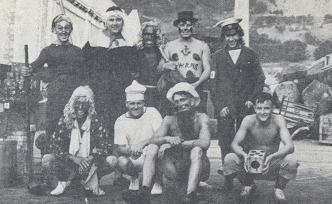
An
Uckers Team, 1942. Between
operations there was time,
little though it was, for
various intership and
intermess sports, soccer,
rowing, and the Navy's own
game of "Uckers", an extra,
large, and equally mad game
of Ludo
The
rest of July and August was
spent escorting the convoys
which were later to be the
spearhead for the landings in
Sicily and, of course, Charybdis
was kept very very
busy flitting here and there,
always at a rush, with little
time in port only to re-fuel
and take on food, water and
ammunition.
Charybdis
put into Mers-el-Kebir.
This bay has a very large
anchorage, situated near Oran,
it was originally the French
Mediterranean Fleet base.
Having been well battered by
the enemy then by the Allies,
on alternative occasions, it
was now just a bay with a
sandy beach. So, again as a
reward for our labours a three
hour beach bathing party was
given. It was considered
unwise to have too many of the
crew ashore under the
circumstances, therefore
numbers were drawn out of a
hat. The ship remained under
"sailing orders" and in fact
we did sail later that
afternoon but somewhat
delayed. The port of Oran,
some miles to the east had
been placed out of bounds with
all Libertymen
warned to keep in sight of the
ship and watch for the "recall
signal." An hour after the
"recall" had been flying the
ship was still waiting for
those "adrift" returning from
Oran. With the last man
aboard, the ship got underway
and all Libertymen
were ordered to fall in on the
Quarterdeck. There was a
mixture of all ranks, and it
was a grim faced Master at
Arms who stated that the
Commander intended to deal
with the situation, instead of
“Defaulters" next morning. All
ranks stood awaiting the
arrival of the Commander. He
duly appeared led by the
"Master" (Jaunty.) The
"Jaunty" barked out the order
"all men who broke bounds and
went to Oran - step one pace
forward - now." There was no
hesitation, shuffling of feet
or looking to right or left,
to see what the next man
intended to do. As smart as a
Brigade of Guards, every man
of all ranks stepped forward
one pace. It was so
spontaneous, so unrehearsed,
so honest and so “Charybdis"
in it's
action. No man who had broken
bounds was going to let some
one else carry the can (take
the blame.). The Commander was
non-plussed
and giving the order "Stand
Fast" retired round the rear
of 'Y' guns. A brief
discussion and the “Jaunty"
reappeared. All the Libertymen
had been in the Commanders
Report, and to save time under
the imminent liability of
going to "Action Stations,"
the Commander had decided that
the punishment given would
apply to all ranks, thus; 3
months stoppage of leave, 7
days pay (scale) and 7 days
stoppage of rum. The 3 month
stoppage of leave was as a
joke, the scale/pay a blow to
men with allowances made out
to their wives/families - but
the stoppage of the "Grog" -
Rum (Nelson's Blood) was
easily overcome. In fact, the
men "under punishment" were
inundated with an extra "tot"
from their respective
shipmates.
Whilst
the incident at Mers-el-Keber
can in no way be excused as
the ship was under sailing
orders, the united action of
the Libertymen
was further proof to the
remainder of the ship's
company that they were all for
one and one for all.
The
reason for the hasty recall
soon became apparent. The
Italians hearing of the
successes of the Allies in
Sicily, and of the capture of
thousands of their troops,
were on the brink of
capitulation. It was decided
that there be a show of
strength of Royal Navy ships
and, if possible, make a
landing at the "Toe" of Italy.
At high speed Charybdis
soon caught up with the main
task Force, and took up a
position on the starboard bow
of the Flagship. It was
appropriate then that Charybdis
should be in that position, as
the Force steamed into the
Straits of Messina.
Charybdis,
with her ship's crest - the
tree in the centre of the
whirlpool - so named in Greek
Mythology as being on that
side of the Straits of
Messina, saw across the narrow
channel the coast line of
Sicily and the point of
Scylla. H.M.S. Scylla was sistership
to Charybdis,
we only met twice on
operations, she
did survive the war. Her name
also comes from the Greek
Mythology of Messina. As fate
would have it, although the
skies were lit with bonfires
on the coastlines by the
Italians rejoicing in what
they thought was the end of
their war, signals were
received indicating the
Germans were anticipating an
attack. Indications came
through that the Germans were
digging in, and using the
Italians as hostages. With the
position obviously very
unstable, and the Allied
Command having a change of
mind, the Force turned back.
Some of the ships put into
Malta, whilst Charybdis
anchored in Bizerte,
North Africa. This port had
been bombed and shelled by
both friend and foe, alike. It
was a shambles, fringed by
grotesque looking palm trees,
which looked as if they had
been slashed by a giant
scythe.
Chapter 8
- Salerno Landings,
another Famous Man,
"Ike"
A
plan had now been put to the
Supreme Allied Commander,
General Dwight D. Eisenhower,
and received his approval. It
was to make a mass landing at
Salerno, on the southwest
coast of Italy. Here was a
good stretch of beach
surrounded by a hilly terrain.
An ideal place for a landing
providing the opposition was
not too strong. Had the Allies
taken the trouble to "reccie"
the area, and all roads
approaching the bay, they
would have seen the enemy
preparing for such a landing.
It was not only an obvious
landing place, but one suspects
the German Intelligence had
worked at it. Consequently
when the first waves of
British troops hit the beach,
they were inundated by enemy
shellfire. Amongst all the
surrounding hills were the
powerful 88mm Tiger tanks.
They were positioned to cover
the whole of the beach. It was
a massacre. Time and time
again the British troops
dashed from their landing
crafts only to be killed or
pinned down at the water's
edge. For three days attempts
to gain a foothold failed.
There were countless
casualties, and the all
powerful Tiger tanks could not
be silenced. Our own
destroyers going in close to
give cover fire were engaged
by the enemy tanks, and
several hit by 88mm shells.
Churchill
was very disturbed at this
setback and after the third
day, we heard him on long wave
radio speaking to the nation
on the gravity of the
situation. At this point, Charybdis
started to embark troops for
further landings at Salerno.
This was an obnoxious
occasion, for whilst the
ship's company of Charybdis
knew every sailing was for
more "action", the embarking
troops thought they were on
their way home. Many had
fought right through the
Desert Campaign,
they were not in organised
battalions but from all
different regiments. These 8th
and 1st Army men came aboard
straight from the desert. Some
with slight wounds although I
saw several with head wounds,
and indeed a number with
bandages over one eye. All
looked extremely fatigued, but
it appeared that if they could
hold a rifle then they could
fight on.
We
on Charybdis
were not pleased by what we
saw. If you are wounded in
action aboard ship in the
Royal Navy, then as long as
your ship keeps fighting, you
are involved. But here we were
embarking men who were battle
weary, wounded and
transporting them to - in all
probability their deaths - or
worse. They should as at first
they presumed, have been
shipped back to the U.K. We
estimated that we took on
board some 500 assorted troops
on our first journey to
Salerno. The situation there
was extremely hazardous,
a foothold on the beach had
still not been achieved when Charybdis
steamed in close to the beach
head. Because of the menace of
the enemy shelling and
occasional bombing, the troops
were ordered over the side,
down scrambling nets and into
landing craft secured
alongside. The landing craft
were then cast off and headed
for the beach. The whole
operation was done with Charybdis
constantly underway,
whilst on her portside various
battleships and heavy cruisers
were sending their shells
overhead, into the enemy held
hills.
Within
a very short time of landing
on the beach, the troops were
killed or lay wounded. We did
not know this at that time, of
course, and being under orders
to return to Tripoli at high
speed, we knew another crisis
was at hand.
Whilst
re-fuelling, we again started
to embark Army personnel,
500/600 troops were taken
aboard. The Charybdis
gave then what extras we
could, fresh bread, a tot of
rum, a fill up of water (from
our condensers,) medical
treatment where needed - and
took responsibility for their
last letters. Reports being
received from the Salerno area
showed no improvement, and the
''Buzz'' going round the ship
was that a Rear Admiral,
or Admiral from Alexander was
to take passage aboard Charybdis,
to size up the situation. Just
before we sailed the
"personality" came aboard, it
was none other than the
"Supreme" himself, General
Eisenhower. With several
American warships operating in
the area, there was one of
their heavy cruisers at
Salerno, this was indeed an
honour. The first thing he did
on boarding with his staff,
was to go on the tannoy
system and introduce himself
to - and using his words –
“Men of the Royal Navy." That
was a winning start and when
he said WE are going to crack
this nut at Salerno, no one
had any doubts that it would
be done.
We
returned at high speed - no
accompanying destroyers, a
point noted with such an
important enemy target aboard
- and found some progress had
been made with a beach hold.
What had apparently transpired,
was that an idea from a junior
officer of the R.N. had been
tried out and succeeded. It
was for a flotilla of
destroyers to steam in line
ahead and, when the wind was
blowing easterly off the sea,
make
a thick black smoke screen.
This the destroyers did and
following behind the smoke
screen, went the infantry
landing crafts. The enemy
pounded the beaches with their
88mm shells but they were
firing blind now, and the
landing British troops made
circular landings away from
the shellfire. Once ashore the
troops fanned out, getting
behind the enemy Tiger tanks.
They were desperate men made
vicious by what they had seen
- and they fought without
mercy. Again we disembarked
our assortment o£ troops,
still keeping underway, into
landing craft alongside. We
gave the troops what we had
left, assisted them to
disembark as speedily as
possible and slowly circled
the area. Meanwhile the
"Supreme" could see for
himself that at last the
operation was succeeding,
however not without further
drama.
Whenever
the enemy thought it was safe
to do so, they had sent out
very high flying bombers to
carry out harassing high level
bombing. These isolated
attacks were more of a
nuisance then a menace,
because they could not obtain
any real accuracy. One such
high flying four-engine bomber
appeared over the Allied naval
force, and five or six salvoes
were fired to drive it off.
Suddenly a black object was
seen to fall from the
aircraft, and as it came down
it turned from side to side.
It was the first of the guided
bombs, radio controlled from
the parent aircraft above. It's
target was an American heavy
cruiser, which had gone in
closer to Salerno Bay for an
extra barrage support. The
guided bomb continued to glide
down, turning as the ship
turned, and eventually struck
the cruiser amidships. It was
a heavy bomb, obvious from the
flash and explosion, and the
cruiser was temporary out of
control. Immediate assistance
was at hand, but whilst this
event was being dealt with
another high flying enemy
aircraft had appeared, and it's
bomb released and directed to
that valiant old battleship -
the Warspite.
It appeared to strike abaft
the funnel, and she was
stopped at once. Damage was
severe, and she had to be
assisted back to Malta. So we
were experiencing another
aspect of the war. But the
landings went on, the
beachhead now solid, and Charybdis
returned with General
Eisenhower to Bizerte.
We
spent three days at Bizerta
resting, before returning to
Gibraltar, and on 1st October
leaving there for the U.K.
Just before we arrived at
Plymouth the Captain announced
that the punishment of 3
months stoppage of leave
previously awarded to some of
the crew was cancelled, and
there was a great cheer from
the ship's company.
Chapter 9
- Charybdis Sails for the
Last Time
.
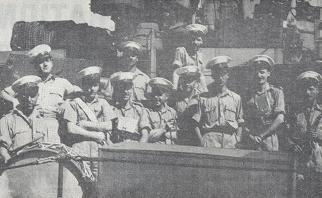
The
R.M. Band (only one member
survived)
During
my years in the Navy and being
Devonport based, any "runs"
ashore at Plymouth I would
spend down at the Barbican.
Though sometimes months would
pass, I knew most of the
regulars in the Ship Inn. As I
was leaving there on the night
of the 21st October, 1943 I
called out "see you Saturday".
Someone called back "no you
won't, you'll be at sea." It
appeared that the cruiser
H.M.S. Black Prince based at
Plymouth had engine trouble,
and as the C-in-C had some
operation in mind, then
Charybdis
was to be the substitute. It
occurred to me at the time,
how strange it was that nobody
I knew aboard ship was aware
we were sailing next day.
Under "Sailing Orders" yes,
but not when and why. The
following day, Friday, 22nd we
had completed re-fuelling, and
re-storing. Some replacements
were made amongst the ship's company,
it appeared that it was the
only way that weary and worn
out personnel could have a
break. By
relieving a few officers and
men, at a time.
So
it was that just after 1900
hours on the 22nd October, Charybdis
sailed for the last time on an
ill conceived and widely known
operation code named -
"Tunnel." The battle summary
of this operation is published
in the Charybdis
Association folder. The
tactics as used by both sides
are fully explained, as are
the reports from the
destroyers in company with Charybdis.
It is not for me to say what
errors were made, or by whom,
but it should be recorded that
Charybdis
had successfully countered
superior numbers of 'E' boats
in the past. On operation
Pedestal her destroyers had
worked well in very difficult
circumstances, and in areas
where there had been little
room to manoeuvre. My action
stations on Pedestal and all
previous operations,
had been on one or other of
the two Pom-Poms,
directly in front of the
Bridge. Having
there a grandstand view as
it were, of all the action
going on. At
the same time getting the
blast whenever "A" of "B"
guns opened fire. As
a consequence my hearing was
damaged and by order of the
sickbay my duties were chanced
to the T.S. (Note –
Transmitting Station), way
down below decks. I was No.1
on the table, and in direct
telephone contact with the
Bridge and all main armament.
I
confess then, to be puzz1ed in
watching the ranges closing
after we made the first radar
contact with the enemy. I
heard someone whom I presume
was the Gunnery Officer say
"we will close in to a range
whereby the secondary armament
could become effective." The
T.S. crew consisted mainly of
Royal Marine bandsmen, the
Bandmaster being senior to
myself and in charge. We were
all conversant with our
duties, and had been together
long enough to have full
confidence. In fact there had
been an air of complete
confidence from the time we
had gone to action stations,
particularly after the Captain
had spoken over the Tannoy
to say this was to be a speedy
job - and we could look
forward to a “Make and Mend"
next day. Sat at the T.S.
table, I watched the ranges
still closing. At this moment
of time our T.S. was watching,
as standby, all the
information being fed to the
Aft T.S. and ourselves. It was
the Aft T.S. which was to
supply the opening fire range,
the fuse settings, relative
speeds, etc., etc. Although
my T.S. could take over
immediately, if say a shell
should destroy the Aft T.S.
We were ready to monitor any
attempted enemy AIR attack,
being close to the French
coast there was a distinct
possibility of that. At the
large metal table where I sat,
there was a white sheet of
stiff paper about the size of
a newspaper. If an enemy
aircraft was picked up on our
aircraft radar, I would start
the paper rolling. A device
would show me the aircraft’s
course, which I would have to
follow most accurately. Around
the table were dials giving me
speeds, heights, ranges - all
the information the modern
radar could supply to me. In
turn I had to pass this
"information" on to the main
armament. In the case of a
concentrated air attack it
could become very hectic.
The
range dial from the surface
radar was now showing l800
yards and closing. 1700 yards,
and a voice over my earphones
said "B guns stand by to fire
Starshell."
A
dial showed me we were
altering course. l600
yards, l500 yards and
Bandmaster Piesse
tapped my shoulder, and by his
gestures indicated we were
going to throw spuds, or hand
grenades at the enemy. He had
his usual grin on his face.
1400 yards, the open-fire gong
went and "B" gun fired Starshell.
Even way down in the T.S. the
distinctive thump could be
felt, and I remember thinking
there will be some "thumping"
in a minute.
Chapter 10
- The Loss of Charybdis and
Limbourne
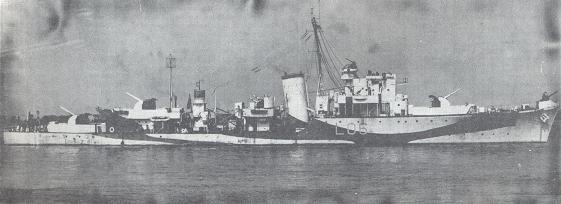
Hunt
class destroyer as Limbourne
Suddenly
there was a terrific
explosion. I left my seat, hit
the deckhead
and fell back across the
table. I did not need to be
told we had been torpedoed.
All the lights had failed,
my earphones were silent and
had slipped round my neck.
Water was rushing in somewhere
and I heard the Bandmaster
calling for the emergency
lighting This
too had failed. The ship was
now listing over to port, so
that in the inky blackness one
could not tell if one was
standing on the deck or on
dividing bulkhead. I had hung
my lifebelt up, on entering
the T.S..
- contrary
to ships "Standing Orders",
and stumbling about nearly had
my head yanked off. My
earphones were still plugged
in, and the strap round my
head brought me up with a
jerk. Piesse
gave the order to leave the
T.S., but it seemed an
eternity before the watertight
door was located and forced
open. Fortunately it had not
jammed, but there was an
immediate in rush of water. We
moved by instinct, groping for
the steel ladder to the next
deck. There was no sound of
gunfire above, and I don't
believe I could feel the throb
of engines.
I do
think, however, that at this
point all the T.S. crew had
managed to vacate the T.S. My
hands found the ladder and
someone was halfway up,
shouting the “hatch" was
fastened/battened down. Piesse
shouted back to knock the
clips off. The clips had
probably been kicked tight,
whilst. the
man below was trying to knock
them off with his hands. The
ship's list did not help, but
between us we opened the
hatch. I still do not know who
it was who climbed out with
me, but at that moment another
explosion, much bigger or
nearer or maybe two close
behind each other, threw us
together against the bulkhead.
It did not do either of us any
good,
and I would think caused a lot
of casualties. The next few
minutes were very hazy but by
the list now of the ship, it
meant getting on to the upperdeck
quickly was imperative.
The
next ladder seemed to be lying
flat instead of vertical, no
wonder because when I got on
the upperdeck
the port side was almost
awash. The old ship seemed to
be sinking fast, from the
stern. One didn't need to jump,
I just kicked off my shoes and
stepped into the "drink."
Having
abandoned ship under similar
circumstances before, I
realised immediately that I
had done two wrong things.
First I should have gone
overboard on the other side,
not only was I in more oil
than water but the ship was
keeling over towards me.
Secondly, I had not stopped to
find anything to keep me
afloat, having no lifebelt. I
seemed to be entirely on my
own, and I struck out as fast
as I could in the oil. To
judge time in those
circumstances is impossible,
but it seemed a long time when
I bumped into a length of
timber. From its size, shape
and the bevelled grooves, I
guessed it was part of the
handrail from the
companionway. Grateful for it's
support, I trod water.
Suddenly a Starshell
burst directly overhead. To my
amazement I was quite close to
the ship, she was illuminated
showing about 25 feet of her
bows sticking straight up, the
rest of her submerged. Sat
astride the bows were three
men, I just could not think
what they were doing up there,
to me the ship was on the
point of sinking completely. I
turned to swim away again from
the ship, losing my
''handrail'' in the progress.
Later,
how long I'll never know, I
saw momentarily on top of a
now rising sea, a small
cluster of little red lights.
At the next lift of the sea,
and as the moon temporarily
broke through I saw clearly
bearing down on me - at high
speed - an enemy Elbe Class
destroyer. Part of my Naval
training over the last 4 years
had been aircraft and enemy
Axis naval recognition. This
destroyer whose wash almost
swept me into it's
screws, was definitely a Elbing
Class, heavy armoured and
fast. (Later in Stonehouse
Hospital, Royal Naval
Intelligence men insisted
there were no Elbe destroyers
in the action.) Postwar
German records show there were
five Elbing
destroyers in the "Tunnel"
battle.
(Note:
The identity of the German
attackers can still seem
clouded with mystery. Some
sources, even now, credit
the loss of Charybdis and
Limbourne to E- or S-boats
– German motor torpedo
boats, which did not take
part in the attack. Most
however, confirm that it
was five torpedo boats of
the 4th Torpedo-boat
Flotilla (S.O. Lt. Cdr. Kohlauf,
T.23, T.26, T.27, T.22 and
T.25) which were
responsible, and not the
much larger Z-type Zerstorers
or fleet destroyers. The
term Elbing-class
does not appear to be
widely used but presumably
applies to this class of
torpedo boats, which were
built by Schichau
at Elbing.
Nevertheless, they were
still formidable enemies,
especially when contrasted
with the British Hunts:
T.22-class
or 1939 Type fleet
torpedo boats, in effect
destroyer escorts -
1,754t deep load,
4-4.1in/4-37mm/7 to
12-20mm/6-21in TT (2x3),
32.5kts, 206
crew
Hunt-class
escort destroyers (Type
3), including Limbourne
and Wensleydale – c1,545t
deep load, 4-4in/4-2pdr
40mm pom
poms,
2-21in TT, 27kts, 168
crew.
And even
Charybdis only mounted
4.5in main armament.)
It
was obvious, by the speed of
the enemy destroyer,
that they were not
going to pick up any
survivors. A short time
later there was a heavy
explosion under water, the
shock waves of which struck
the body like being hit with
a large plank. I had no idea
then what it was, but from
the operation "Tunnel"
reports it would have been
our own forces torpedoing
the crippled H.M.S. Limbourne.
The combination of the cold
sea, oil everywhere, and
having the breath knocked
out of one, brought the
realisation that things were
now out of my hands. I think
the thought of my Mother
getting another dreaded
Admiralty telegram spurred
me on, and again I saw the
little red lights.
Eventually
I reached them. It was a Carley
float, and hands reached to
grab me to them. Inside the
Float were two badly wounded
men and hanging on the
lifelines on the outside
were 16 others, two or three
I recognised as young Boy
Seamen. There was only
sufficient room for each
person to put one arm
through a line, and then
with hands clasped hang on.
After a while the body
became numb, and the cold
more intense. One by one,
men and boys were letting
go, drifting away. Nobody
had the strength to hold
them back. Some became
unconscious and by the
ridiculous design of the Naval
lifebelt, the head fell
forward and the person
drowned. The oil fuel was
now having it's
effect, and my retching no
longer cleared the
breathing. The clinging grip
of it seemed to be
everywhere, nose, mouth,
eyes and hands. The seas
were rising too and the Carley
Float was rearing up on the
crest of each wave, tumbling
down into the trough, to be
met by the next white capped
sea. It must have cast off
some man every time it did
this half somersault,
because there was more space
around the float. By now I
was not aware of any feeling
in the lower part of my
body.
I
consider it my
responsibility to record
here that conditions were
the same, with the few other
Carley
floats that had survivors
around them. Indeed one
"float" similarly
over-manned in it's
early stage was approached
by the Captain, and the men
urged him to join them. But
turning and swimming away,
he called "keep going, help
will be here soon." He lies
now with over a hundred
officers and men at Dinard,
near St. Malo,
Brittany. Over eighty men
were buried at St. Bruic,
Brittany thirty eight at
Howard Park, Jersey,
nineteen at Le Foulon,
Guernsey, and the ship's
Padre with two unidentified,
on the island of Isle de
Bas. More than five hundred
officers and men died that
night.
At
what time the seas abated I
do not know. A heavy swell
persisted and there appeared
to be the first signs of
dawn. The "float" had now
just four of us hanging on it's
sidelines, with two
motionless bodies lying
inside. It brightened still
further, and I looked at the
man next to me. He was
totally unrecognisable, only
the white of the eyes
showing. I tried to speak
but could not, neither
it seemed could he.
As the "float" rose on the
crest of a large swell I saw
to my left a faint sign of
land, with my eyes gummed up
with oil it could not have
been all that far away.
Another big land swell, and
over to my right I could see
a destroyer and not all that
far away. Each lift of the
"float" gave me another
sight of her. She was
stopped now, broadside on. A
Hunt Class, one of ours. But
had she seen us? she
must be in range of enemy
shore batteries, and with
the coming light in danger
of air attack.. Being
stopped she was a target for
any ‘U’ boat. I tried to
tell the others she wouldn't
wait - lets swim for it -
but I could only speak with
one hand. That was it,
I must try and reach her
before she got underway
again. I let go the lifeline
and struck out. Two, three
strokes and everything went
black.
The
names of the two Petty
Officer's who dived into
those October seas with
lifelines attached, and
saved the other three men
(unfortunately the two
inside the "float" had died)
are P.O. Johnson and P.O.
Guy, of H.M.S. Wensleydale.
The time, 0625 hours,
exactly 25 minutes after the
FINAL order from C-in-C
Plymouth to clear the area.
Two previous orders to do so
had not, fortunately been
carried out.
H.M.S.
CHARYBDIS sank a.m. 23rd
October, 1943 - 337 Deg.
North of the Triagoz
Light, 10 miles.
The
monument erected by the
French, to her officers, men
and boys is position -
Monument, Saint Quay, Portreux
(route de Paimpol)
directly due south of where
she now lies.
FOR
H.M.S CHARYBDIS, the "DAY'S
WORK WAS OVER"
Postscript
In
writing the story of H.M.S.
CHARYBDIS 1941 - 1943, there
have been many untold
memories of comradeship,
gallantry, humour, and even
romance. The few survivors
will recall the varying
incidents in their memories.
I
am indebted to fellow
survivors for their help and
encouragement: to Leonard
Bates, to John Eskdale
for supplying me with the
extracts from Sir Noel
Coward's diary. John and I
were the last two survivors
to be picked up, at 06.25
hours, 23rd October, 1943.
We met again 31 years later
by a million to one chance,
when visiting the new H.M.S.
CHARYBDIS on Navy Days, at
Portsmouth. That was to be
the start of the forming of
the now "CHARYBDIS
ASSOCIATION".
On
the on the expiration of the
30 year Post War Secrets
Act, I have confirmation on
the CHARYBDIS'S service in
the Royal Navy. My account
of Salerno, where we now
know the Germans had five
Divisions, including
Panzers, prepared and
waiting. Verification
of the signal from the
U.S. heavy cruiser, "What
ship, clear my fire".
Ike ordered the reply,
"H.M.S. CHARYBDIS, Royal
Navy, General
Eisenhower in command. Keep
your fire on enemy. "
German
Naval War Directives record
that on the night of
22nd/23rd Oct. 1943, Elbe
Class destroyers lay in
wait, guided by shore Radar
directions. Their flotilla
fired 30 torpedoes at the
British cruiser, and her
destroyers. After the
general melee they steamed
due west at 32 knots, the
British surviving force in
chase, at 25 knots. The
chase was fruitless, and
over 300 CHARYBDIS men died
in the icy waters. Over 500
men and boys,
were lost with CHARYBDIS,
and 47 on the destroyer
LIMBOURNE.
We
now know that Officers, and
men, are buried at Dinard,
St Brieuc
and St. Charles de Percey,
Brittany, and Howard Davis
Park, Jersey, and Le Foulon
Guernsey. Some wounded
survivors died on the
rescuing destroyers, and are
buried at Weston Mill
Cemetery, Devonport. Others
died at R.N. Hospital,
Plymouth.
The
C.O. of the enemy force was
Lieut. F.K. Paul, of
destroyer T23 (armament 2 x
triple 21" torpedo tubes, 4
x 4.1" gun turrets, 6 x 1.5"
A.A., speed, 36 knots. T23
led the attack. In December
1943 the British again swept
the Brittany coast. Three
enemy destroyers were sunk.
No British ship sunk, but
WENSLEYDALE, my rescuing
destroyer was hit by a
shell, and her Captain
killed.
(Note:
in this operation in the
Bay of Biscay on 28
December 1943, light
cruisers ENTERPRISE and
GLASGOW were in action
with eleven German
destroyers and torpedo
boats, sinking destroyer
Z.27 and two of the
torpedo boats involved in
the loss of CHARYBDIS –
T.25 and T.26. Sadly I
cannot find confirmation
that WENSLEYSDALE took
part in this action. The
only British casualties
appear to have been two
men killed in GLASGOW)
Finally,
in 1983, I was to meet the
man who dived off H.M.S.
WENSLEYDALE and swam to save
my life as I became
unconscious. He was, then,
P.O. Stanley Guy, and was
decorated for his act. The
other WENSLEYDALE man was
P.O. Johnson, also
decorated, but was later
killed.