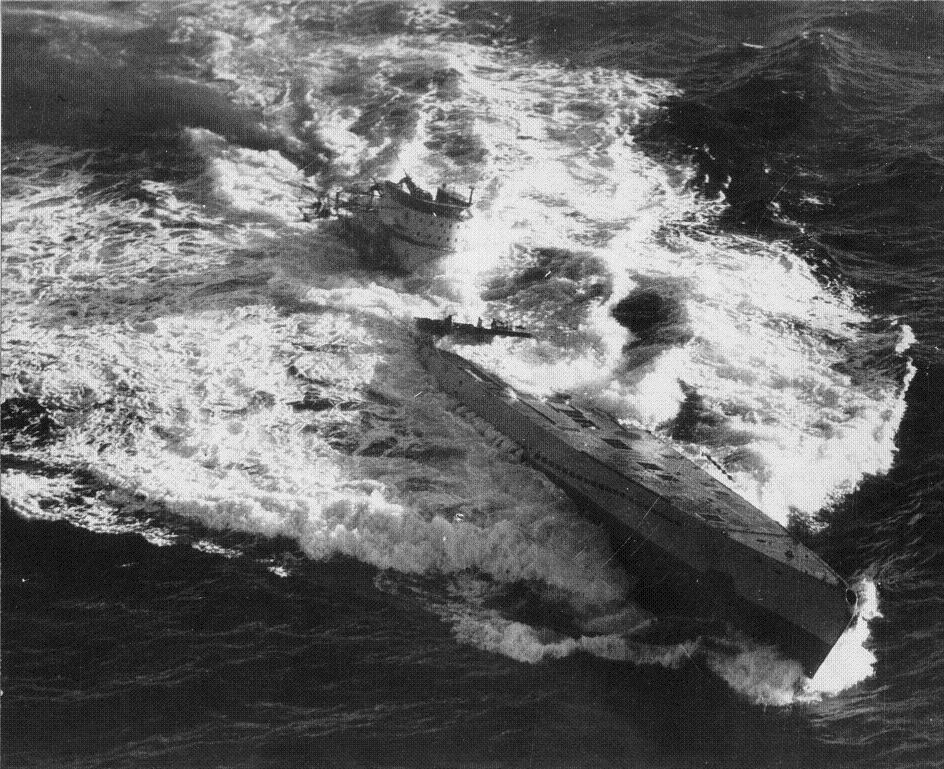
1943
JANUARY
1943
Atlantic
Russian
Convoys
- Russian convoy
JW52 and return RA52 both
set out in January. Of the 25 ships in
the two convoys,
one left JW52 to return to port, and one
merchantmen with
RA52 was lost to U-boat
attacks.
Battle
of
the Atlantic -
Severe weather and evasive convoy
routing kept losses
down in January 1943. However, south of
the Azores, out
of range of air cover,
Trinidad/Gibraltar tanker convoy
TM1 lost seven out of nine ships to
U-boats.
Monthly Loss
Summary,
including Russian Convoys
- 30
British, Allied and neutral ships of
189,000 tons in the
Atlantic from all causes
- 4
U-boats including 1 by RAF in North
Atlantic; 2 by US
aircraft off Brazil; 1 by unknown causes
Europe
Air War
- RAF
Bomber Command by night and increasingly
the USAAF by day
mounted a growing attack on Germany and
occupied Europe. U-boat bases and their
production centres
were major targets in 1943, yet in the
first six months,
not one U-boat
was
destroyed
in air-raids and the construction
programmes were hardly
affected. Throughout the war not one
U-boat
was
lost
in the incredibly strong,
reinforced concrete shelters built by
the Germans at
their main bases including on the French
west coast.
Mediterranean
Casablanca
Conference -
Prime Minister Churchill and President
Roosevelt with
their Chiefs of Staff meet for this
important conference.
Major areas for discussion included the
European invasion
in 1944, landings in Sicily and Italy
after the Tunisian
campaign, the bombing of Germany and the
continuation of
the war in Burma and the Pacific. Losses
due to U-boats and the shortage of
shipping
proved to be significant constraints on
Allied plans.
13th -
Axis attacks
continue against Allied ships in
Algerian ports and
convoys off the coast. Canadian corvette
"Ville de
Quebec" sank "U-224" west of Algiers.
21st
-
Submarine "Sahib" on patrol off western
Corsica
sank "U-301".
|
PROSPECTS
FOR ALLIED
VICTORY - The
Russians gained a famous
victory
with the German surrender at
Stalingrad in January 1943.
Taken
with the October 1942
British Battle of
El Alamein and
June 1942 American Battle of
Midway, the three Allied
successes are usually
considered as marking the
turning point in the 40
month old war against the
Axis powers. The Battle for
Guadalcanal, ending as it
did Japanese
hopes of controlling the
South West Pacific
should also be added to this
roll-call of
victory. However, more than
30 months of struggle
and bloodshed had to be
endured before victory
was certain. Even then, one
battle was not over
until the very end - the
Battle of the Atlantic
against the U-boat,
although it did peak over
the next four months.
|
FEBRUARY
1943
Atlantic
Attack
on
Slow Halifax/UK Convoy SC118 - SC118,
escorted by the British B2 group
was heavily attacked in mid-Atlantic. A
total of 20 U-boats sank 13 of the 63
merchantmen.
However, on the 4th "U-187" was
detected by HF/DF, hunted down and
sunk by destroyers "Beverley" and
"Vimy". Three days later, Free French
corvette
"Lobelia" sank "U-609" and a RAF B-17
Flying Fortress
accounted for "U-624".
17th -
Slow
UK/North America convoy ONS165 and the
escorting British
B6 group were attacked east of
Newfoundland. "U-201"
was
sunk
by destroyer "Fame"
and "U-69" by "Viscount". Only two
merchantmen were lost.
22nd -
U-boats attacked ON166 and its American
A3
group in mid-Atlantic and sank 14 ships
in the course of
four days. In exchange "U-606"
was depth-charged
to the surface by Polish
destroyer "Burza" and Canadian corvette
"Chilliwack", and finished off by
ramming by US
Coast Guard cutter "Campbell".
22nd -
Mines laid
by "U-118" in the Strait of Gibraltar
sank
three merchantmen and on the 22nd
Canadian corvette "WEYBURN" as she
escorted North Africa/UK
convoy MKS8.
23rd -
UK/Caribbean
tanker convoy UC1 lost badly to U-boats,
but southwest of
Madeira, "U-522"
was
sent
to the bottom by cutter
"Totland".
Russian
Convoys
- Russia-bound
convoy
JW53 sailed with 28 merchantmen.
Six turned
back because of the weather, but the
rest reached Kola
Inlet on the 27th. Return convoy RA53
with 30 ships lost
three to U-boats
in March. These were the last convoys to
or from Russia
until November 1943 - a gap of nine
months, because of
the pressure of events in the North
Atlantic
Monthly Loss
Summary
- 50
British, Allied and neutral ships of
310,000 tons in the
Atlantic from all causes, 1 corvette
- 15
U-boats including 5 by RAF in North
Atlantic and off
Portugal and Gibraltar; 2 by RAF and US
aircraft on Bay
of Biscay patrols; 1 by US Navy in North
Atlantic.
Mediterranean
1st -
As
cruiser-minelayer "WELSHMAN"
sailed
from
Malta to Alexandria after
minelaying operations in the Strait of
Sicily, she was
sunk by "U-617" north of Bardia.
North
Africa - As
Rommel prepared his Mareth line defences
in southern
Tunisia, Eighth Army units crossed the
border from Libya
on the 4th. All Libya was now in Allied
hands and the
Italian North African Empire ceased to
exist.
17th -
"U-205" attacked
Tripoli/Alexandria convoy TX1
northwest of Derna, and was then sunk by
South African
aircraft of No 15 Squadron and destroyer
"Paladin".
19th -
Combined air
and sea attacks also accounted for
"U-562" northeast of Benghazi. This time
the convoy was Alexandria/Tripoli XT3,
the warships
destroyers "lsis" and "Hursley" with
aircraft from No 38 Squadron RAF.
23rd -
German and
Italian operations against Allied
shipping off Algeria
led to further losses on both sides. A
patrol of escort
destroyers "Bicester", Easton",
Lamerton" and Wheatland" shared in the
sinking
of "U-443" to the northwest of Algiers.
MARCH
1943
Atlantic
4th -
In operations
against the US/Gibraltar routes, "U-87"
was
sunk
off Portugal by Canadian
destroyer "St Croix" and corvette
"Shediac".
11th -
North
American/UK convoy HX228 (60 ships),
escorted by the
British B3 group, lost a total of four
ships. Destroyer "Harvester" rammed
"U-444" but was disabled and the U-boat
had to be finished off by French
corvette
"Aconit". "HARVESTER", now stationary,
was sunk by "U-432" which in turn was
brought to the
surface in mid-Atlantic by "Aconit's"
depth
charges and finally destroyed by gunfire
and ramming.
Battle
of
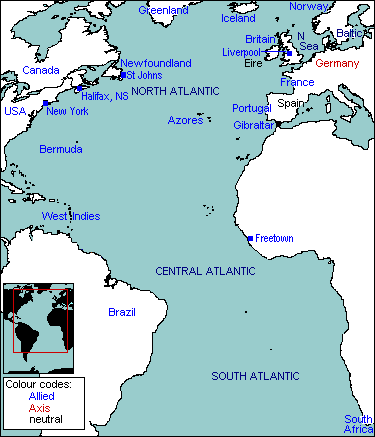
the Atlantic - Throughout
the war a large proportion of the
losses due to U-boats
were
among
independently routed merchantmen and
stragglers from convoys, but in March
1943 the Germans
came close to overwhelming well escorted
convoys. Between
the 7th and 11th, slow convoy SC121 lost
13 ships. Worse
was to come between the 16th and 20th in
the largest
convoy battle of the war - around HX229
and SC122. Over
40 U-boats
were
deployed
against the
two as they slowly coalesced in the
mid-Atlantic air gap
until there were 100 ships plus escorts.
Twenty U-boats
took
part in the attack and sank 21
merchantmen before additional air and
surface escorts
finally drove them off. A RAF Sunderland
accounted for
the one U-boat
destroyed. Again the German B-Service
was responsible for
providing Doenitz' packs with accurate
convoy details and
routeing. These losses took place at
another turning
point in the secret war around the
Enigma codes. Early in
the month the U-boats
changed from three-rotor to the far more
complex
four-rotor 'Triton' code. Yet by month's
end this had
been broken by the men and women of
Bletchley Park and
their electromechanical computers. The
Allies' tremendous
advantage was restored. This came at the
same time as a
number of other developments, which
together brought
about a complete reversal in the war
against the U-boats.
The first five Royal Navy support groups
with modern
radars, anti-submarine weapons and HF/DF
were released
for operation in the North Atlantic. Two
were built
around Home Fleet destroyers, two around
Western
Approaches escorts, including Capt
Walker's 2nd Escort
Group, and one with escort carrier
"Biter".
Escort carriers "Archer" and the
American
"Bogue" were also ready for action, but
"Dasher"
was
unfortunately
lost
in UK waters. Nevertheless, the
mid-Atlantic air gap was
about to be finally closed. Another
major breakthrough
was again in the air war. Aircraft were
being fitted with
the 10cm wavelength radar which was
undetectable by U-boat Metox receivers.
The new radar and
the Leigh light made a powerful weapon
against surfaced
submarines, especially as they tried to
break out through
the Bay of Biscay air patrols. More VLR
aircraft were
also joining Coastal Command to extend
further the Allies
grip on the convoy routes throughout
their length.
Monthly Loss
Summary
- 90
British, Allied and neutral ships of
538,000 tons in the
Atlantic from all causes, 1 destroyer
- 12
U-boats including 4 by the RAF in North
Atlantic; 1 by
RAF Bay of Biscay patrols; 1 by US
aircraft off Barbados;
2 by US forces off the Azores and Canary
Islands; 1 by
unknown causes
APRIL
1943
Atlantic
2nd -
"U-124" on passage to the Freetown area
encountered UK/West Africa convoy OS45
to the west of
Portugal. Two merchant ships were sunk,
but she was
attacked by sloop "Black Swan" and
corvette
"Stonecrop" of the 37th EG and sunk in
turn.
6th -
In attacks on
Halifax/UK convoy HX231 southwest of
Iceland, two U-boats were lost - "U-635"
to frigate "Tay" of the
British B7 group and "U-632" to a RAF
Liberator. Six of the
convoy's merchantmen were lost to the
15-boat pack.
(Note: the identity of these two U-boats
is sometimes
reversed.)
7th -
Submarine
"Tuna" on Norwegian Arctic patrol sank
"U-644" northwest of Narvik.
11th - Destroyer
"BEVERLEY"
of
the British B6 group escorting convoy
ON176 was sunk
south of Greenland by "U-188".
18th -
"U-123" on patrol south of Freetown
torpedoed
and sank "P-615" (ex-Turkish) on passage
to the South
Atlantic Command to provide
anti-submarine training.
Battle
of Slow UK/North America Convoy ONS4
- ONS4
(these convoys were renumbered
starting in March) was escorted by the
British B2 group
(Cdr Macintyre) and reinforced by the
5th Escort Group
with escort carrier "Biter". On the 23rd
"U-191"
was
detected
to the south of Greenland
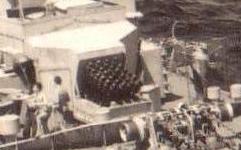
by HF/DF and sunk by destroyer
"Hesperus" using the Hedgehog
forward-throwing A/S mortar (pictured
below). Two days later
on the 25th a Swordfish of 811
Squadron from
"Biter" found "U-203" and destroyer
"Pathfinder" finished her off.
Battle
of
the Atlantic - U-boat
strength was up to 425 with 240 boats
operational, and over half of them on
passage through or
on patrol throughout the North Atlantic.
However, there
was somewhat of a lull until the end of
the month with
the start of the ONS5 battle. A group
also operated once
again in the weakly defended Sierra
Leone area. In just
one night "U-515" sank seven of the 18
ships in
Takoradi/Sierra Leone convoy TS37.
Changes were again
made in the Allies' responsibility for
the North Atlantic
routes. As agreed at the March 1943
Atlantic Convoy
Conference in Washington: (1)
Royal Canadian Navy was to
exercise full control of the northerly
routes west of the
47-00'W CHOP line - approximately south
of Greenland; (2)
Royal Navy took over to the east of
47-00'W; (3)
US Navy
was to look after the southerly
convoys,and also the
CU/UC tanker routes between the West
lndies and UK. With
these organisational changes, the far
more effective
convoy Escort Groups, and the
developments described
in March, the
scene was set for the decisive
convoy battles of May 1943.
Monthly Loss
Summary
- 40
British, Allied and neutral ships of
242,000 tons in the
Atlantic from all causes, 1 destroyer
and 1 submarine
- 14
German and 1 Italian U-boats including 3
by the RAF in
the North Atlantic and off the Canaries;
1 by RAF Bay of
Biscay patrol; 1 by RAF-laid mine in the
Bay of Biscay; 1
by RAAF north of the Faeroes; 3 to US
forces in the North
and South Atlantic, including the one
Italian
MAY
1943
Atlantic
United
States -
Winston Churchill travelled across the
Atlantic in the
troopship "Queen Mary together with
5,000 German
POWs for the Trident Conference, the
third major meeting
in Washington DC.
The
May 1943
Convoy Battles -
Victory of the Escorts
At
the beginning
of the month over 40 U-boats
were
deployed
in three patrol
lines off Greenland and
Newfoundland. Another
group operated to the far
west of the Bay of
Biscay. A number were
passing through the
northern transit area and
over 30 on passage
between their Biscay bases
and the North
Atlantic. More still were on
patrol in the South
Atlantic or passing through.
There were numerous
Allied convoys crossing the
North Atlantic as
suitable targets, starting
with ONS5:
(1)
Slow
UK/North America ONS5
- On the 21st April,
ONS5 sailed with 42
ships from Liverpool
outward bound for North
America. Escort was
provided by the British B7
group (Cdr P. W. Gretton)
with
two destroyers, a frigate,
four corvettes and two
trawlers. The first threat
was dealt with before
the end of April when
"U-710"
was
sunk
by an escorting RAF B-17
Flying
Fortress south of Iceland.
The real battle
started in early May, south
of Greenland as all
three U-boat patrol lines
closed in. Before they
arrived the escort was
reinforced by the 3rd Escort
Group (EG) from
St John's, Newfoundland.
Rough seas made
refuelling difficult and
some of the escorts had
to leave. The 1st EG, also
from St John's sailed to
replace them. Over the next
few days 13
merchantmen
were
lost,
but at a cost of a
further
six
U-boats. All went down in
often
confused fighting to the
south of Greenland or
northeast of Newfoundland.
More still were
damaged. Type 271 radar
played a large part in
the escort's successes: 4th
- "U-630" to a RCAF Canso
(Catalina). 5th - B7
group corvette
"Pink" sank "U-192", sister
ship
"Loosestrife", also from B7
sank "U-638". 6th -
B7 group
destroyer "Vidette" sank
"U-125". Destroyer
"Oribi" detached from convoy
SC127 to
join B7 together with
corvette
"Snowflake" accounted for
"U-531". (The identity of
"U-125" and "U-531" is
reversed in some sources.)
Finally, "U-433"
was
sunk
by sloop "Pelican" of
the 1st EG.
The
surviving U-boats
were
regrouped for attacks on
other convoys, but in the
area south of
Greenland/northeast of
Newfoundland as well as
throughout the North
Atlantic, merchantmen
sinkings went down as U-boat
losses mounted
alarmingly. Much of this was
due to the way escort
groups (EG) moved from one
convoy to another to support
the existing
escorts. The number of
convoys crossing the North
Atlantic in both directions
was truly impressive
and the main movements in
May, together with the
U-boats sunk is listed here:
(2)
North
America/UK HX236 - 46
ships escorted by British B1
group and 2nd EG (Capt
Walker); no merchant
ship losses
11th
-
"U-528" was damaged by US
aircraft in an
earlier attack on ONS5.
Now southwest of
Ireland, she was sunk by
sloop
"Fleetwood" and RAF aircraft
of No 58
Squadron.
(3)
Slow
UK/North America ONS6 -
31 ships escorted by British
B6
group and 4th EG with escort
carrier
"Archer"; no merchant ship
losses.
(4)
North
America/UK HX237 - 46
ships escorted by Canadian
C2 group and 5th EG with
escort carrier
"Biter". Three stragglers
sunk in exchange for
possibly
three U-boats in
mid-Atlantic: 12th -
"U-89" to destroyer
"Broadway" and frigate
"Lagan", both of C2 group,
assisted by
Swordfish of 811 Squadron
from "Biter".
12th - RAF B-24
Liberator of No 120
Squadron damaged either
"U-456" or "U-753",
which may had been finished
off by destroyer
"Pathfinder" of the 5th EG.
Alternatively one of these
U-boat may have gone
missing on the 15th.
(Sources vary.) 13th
- Either "U-456" or "U-753"
was then
detected by RCAF
Sunderlands of No 423
Squadron which brought up
frigate "Lagan" and Canadian
corvette
"Drumheller" to sink the
U-boat.
(5)
North
America/UK SC129 - 26
ships escorted by British B2
group, with 5th EG
transferred from HX237 on
the 14th. Two merchant ships
lost in mid-Atlantic for two
U-boats:
12th - "U-136" to
destroyer
"Hesperus" of B2 (Cdr
Macintyre). 14th
- "U-266" to a RAF B-24
Liberator of
No 86 Squadron.
(6)
UK/North
America ON182 - 56
ships escorted by Canadian
C5
group, with 4th EG and
carrier
"Archer" transferred from
ONS6; no merchant
ship losses.
(7)
North
America/UK HX238 - 45
ships escorted by Canadian
C3
group; no merchant
ship losses.
(8)
Slow
UK/North America ONS7
- 40 ships escorted by
British B5
group, with 3rd EG
transferred from ONS5. One
ship
lost for two U-boats
destroyed in the vicinity
of the convoy to the
southeast of Greenland and
south of Iceland: 14th
- "U-657" to a US Navy
Catalina. 17th
- "U-640" to frigate
"Swale" of B5. (The identity
of
"U-657" and "U-640" was
reversed in some sources.)
(9)
UK/NorthAmerica ON183 -
32 ships escorted by British
B4
group, no merchant
ship losses.
(10)
North
America/UK SC130 - 38
ships escorted by British B7
group, with 1st EG
transferred from ONS5. No
merchant
ship losses in
exchange for four U-boats
south of Greenland: 19th
- "U-954" to a RAF
Liberator; "U-209" to
frigates
"Jed" and "Sennen" of 1st
EG;
and "U-381" to destroyer
"Duncan
and corvette Snowflake of
B7. 20th - "U-258"
to another RAF Liberator -
both VLR aircraft from the
very successful No 120
Squadron.
(11)
UK/NorthAmerica
ON184 - 39 ships
escorted by Canadian C1
group and US 6th EG with
escort carrier
"Bogue". No merchant ship
losses in exchange for one
U-boat: 22nd -
"U-569" in mid-Atlantic to
Avengers flying from
"Bogue".
(12)
North
America/UK HX239 - 42
ships escorted by British B3
group and 4th EG and carrier
"Archer" transferred from
ON182 (and
before that ONS6). No
merchant ship losses in
exchange for one more
U-boat: 23rd - In
the
first success with aircraft
rockets, "U-752" in
mid-Atlantic was badly
damaged by "Archer's"
Swordfish of 819
Squadron, and scuttled as
surface escorts
approach.
By
the 24th,
U-boat losses were so heavy
and the attacks
so fruitless, Adm Doenitz
ordered his captains to
leave the North Atlantic
battlefield. They either
returned home or
concentrated on the
US/Gibraltar
routes. It was some time
before the Allies
realised the North Atlantic
was almost free of U-boats.
The British and Allied
air and sea escorts were
winning.
26th
-
"U-436"
was
sunk
west of Cape Ortegal, Spain
by
frigate "Test" and Indian
corvette
"Hyderabad".
(13)
North
America/UK SC131 - 31
ships escorted by British B6
group, 3rd and 40th EGs ; no
merchant
ship losses.
(14)
Slow
UK/North America ONS8
- 52 ships escorted by
Canadian C4
group and 2nd EG (Capt
Walker) transferred
from HX236 ; no merchant
ship losses.
(15)
North
America/UK HX240 - 56
ships escorted by Canadian
C5
group and 2nd EG from ONS8.
No merchant
ship losses in
exchange for one U-boat: 28th
- "U-304" to a RAF Liberator
of No
120 Squadron south of
Greenland.
Summary
statistics
for these North Atlantic
convoy
actions
15
convoys totalling 622
merchantmen
seven British B and five
Canadian C convoy
groups
six British and one US
supporting Escort
Groups
three escort carriers
Well
over 70 U-boats at sea
23 German U-boats sunk
11
convoys were unscathed,
four convoys lost 19
ships - a loss rate
of 3 percent
Without the heavy losses
of ONS5, loss
rate was 1 percent
Without
the U-boats sunk in
attacks on OSN5, 16
U-boats were lost in
exchange for 6
merchantmen
|
Monthly
Loss Summary
- 40
British, Allied and neutral ships of
204,000 tons in the
Atlantic from all causes
- 37
German and 1 Italian U-boats. In
addition to those lost
in or around the convoy battles: 3 by
RAF in North
Atlantic; 6 by RAF and RAAF Bay of
Biscay patrols; 4 by
US forces in the North Atlantic, off
Florida and Brazil;
2 by collision in the North Atlantic
Mediterranean
21st -
Submarine
"Sickle" on patrol south of Toulon,
France
torpedoed and sank "U-303".
25th -
Four days
later escorting corvette "Vetch" sank
"U-414" northeast of Oran.
Merchant
Shipping War -
The end of the Tunisian campaign marked
a major upturn in
the fortunes of Allied shipping. By
mid-month
minesweepers had cleared a channel
through the Strait of
Sicily, and the first regular
Mediterranean convoys since
1940 were able to sail between Gibraltar
and Alexandria.
The long haul around the Cape of Good
Hope to the Middle
East was no longer necessary. The
opening of the
Mediterranean was equivalent to
commissioning a large
amount of new Allied merchant ship
tonnage.
Indian
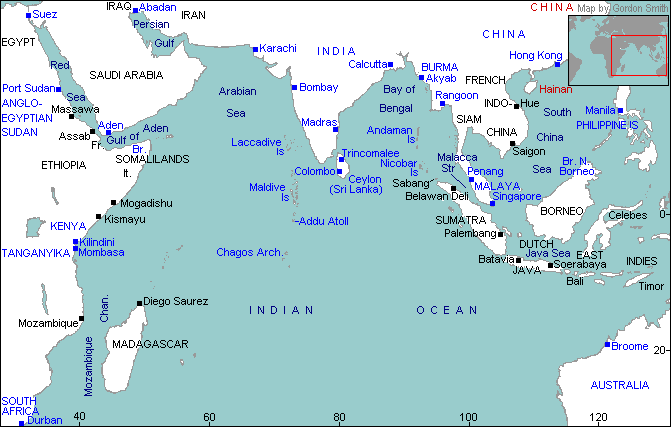
& Pacific Oceans
Merchant
Shipping War -
Adm Somerville's Eastern Fleet had lost
its remaining big
ships to other theatres. An inadequate
anti-submarine and
escort force was left to deal with the
submarines active
in the Indian Ocean. Japanese boats were
again being
joined by German U-boats,
and right through until December 1943
not many more than
a dozen German and Japanese boats
inflicted quite heavy
losses throughout the length and breadth
of the Indian
Ocean. Between June and year's end they
sank over 50
merchantmen.
DEFENCE
OF TRADE - January 1942 to May
1943
Total
Losses = 2,029 British, Allied
and neutral ships of 9,792,000 tons
( 576,000 tons
per month)
By
Location
|
Location
|
Number
of
British, Allied, neutral
ships
|
Total
Gross
Registered Tonnage
|
|
North
Atlantic
|
1,234
|
6,808,000
tons
|
|
South
Atlantic |
97
|
611,000
tons
|
|
UK
waters |
105
|
248,000
tons
|
|
Mediterranean
|
129
|
598,000
tons
|
|
Indian
Ocean |
230
|
873,000
tons
|
|
Pacific
Ocean |
234
|
654,000
tons
|
By
Cause
Causes
* in
order of tonnage sunk
(1., 4. ... -
Order when weapon first
introduced) |
Number
of
British, Allied, neutral
ships
|
Total
Gross
Registered Tonnage
|
|
1.
Submarines |
1,474
|
8,048,000
tons
|
4.
Aircraft
5. Other causes
6. Raiders
2. Mines
3. Warships
7. Coastal forces |
169
228
31
71
31
25
|
814,000
tons
348,000 tons
202,000 tons
172,000 tons
130,000 tons
78,000 tons
|
JUNE
1943
Atlantic
1st -
After
supporting convoys ONS8 and HX240, Capt
Walker's 2nd EG
located "U-202" south of Greenland. She
was sunk by sloop
"Starling".
Bay of
Biscay Patrols
- Aircraft of Coastal Command continued
covering U-boat exit routes from western
France
and were joined by surface escort groups
covered by
cruisers. At the same time U-boats
were
fitted
with heavy AA armament to
enable them to fought their way out on
the surface in
groups. U-boat
sinkings went down as Allied aircraft
losses mounted, but
four U-boats
were
destroyed:
1st - "U-418" to a rocket-firing
RAF
Beaufighter. 14th - "U-564" to
a RAF Whitley. 24th -
The 2nd EG (Capt Walker) accompanied by
cruiser
"Scylla" accounted for two submarines
northwest
of Cape Ortegal, NW Spain. Tanker
"U-119"
was
brought
to the surface and rammed by
"Starling". With her Asdic out of action
from
the ramming, "Starling" left the sinking
of "U-449" to "Wren",
"Woodpecker", "Kite" and "Wild
Goose".
Northern
Transit Area -
In the waters through which
Norwegian-based U-boats had to sail for
their patrol
areas, two submarines were sunk: 4th
- Submarine
"Truculent" on anti-U-boat patrol
between Norway and Iceland
sank "U-308" north of the Faeroe
Islands. 11th
- A RAF Fortress accounted for "U-417"
in the same northern transit area.
14th -
In the North
Atlantic "U-334" and other U-boats
simulated the radio transmissions of
large
wolf packs. She was located and sunk by
frigate
"Jed" and sloop "Pelican" of the 1st
EG.
Battle
of
the Atlantic - The Royal
Navy had
finally changed the convoy codes
and made them secure against the work of
the German
B-Service. In contrast, the British
'Ultra' work was
fully integrated into the Admiralty
U-boat Tracking Room,
and an almost complete picture of German
Navy and U-boat operations was
available. Not one
North Atlantic convoy was attacked
during the month
although U-boats
were
operating
around the Azores. As Allied air
and sea forces grew in strength and
effectiveness,
especially through the use of 10cm radar
and 'Ultra', Adm
Doenitz sought other ways to regain the
initiative. This
he was never able to do, although right
through until the
last day of the war, the Allies could
not relax their
efforts, and continually introduced new
detection
systems, weapons and tactics. Against
numerous,
well-trained and effectively used
escorts, the day of the
conventional submarine was drawing to a
close. The
Germans placed much faith in the Walther
hydrogen
peroxide boat now under development,
which with its long
underwater endurance and high speed,
would have proved a
formidable foe, but it did not get
beyond the
experimental stage by war's end. An
interim step on the
road towards the 'true' submarine
started at the end of
1943 with the design and building of
Type XXI ocean and
XXIII coastal boats. Using the
streamlined hull of the
Walther and high capacity batteries,
their underwater
speed made them faster than most
escorts. Fortunately for
the Allies they did not enter service in
numbers until
too late in 1945. For now the Germans
had to rely on the U-boats currently in
service and building.
Total numbers stayed at around the 400
mark for the
remainder of the war, in spite of a 40
boat per month
construction programme, and various
steps were taken to
improve their offensive and defensive
capability. Apart
from extra AA armament, the Gnat
acoustic torpedo was
introduced specifically to combat the
convoy escorts. Its
first test came in September 1943.
Before then in July,
the schnorkel, a Dutch development that
allowed batteries
to be recharged at periscope depth,
started trials. It
did not enter general service until
mid-1944, but then
went quite some way to nullifying the
radar of the air
escorts and patrols. Even now the German
Navy was unaware
the Allies were using short wavelength
radar, but when
they did, early in 1944, an effective
detector was
shortly introduced.
Monthly Loss
Summary
- 7
British, Allied and neutral ships of
30,000 tons in the
Atlantic from all causes,
- 16
German and 1 Italian U-boats including 4
by US and RAF
aircraft off Iceland and the Strait of
Gibraltar, and the
Italian boat in the North Atlantic; 3 by
the US Navy, one
off the east coast of America and two to
escort carrier
"Bogue" off the Azores; 1 by French
aircraft
off Dakar.
JULY
1943
Atlantic
15th -
"U-135" attacked
UK/West
Africa convoy OS51 off the
Canary Islands, and was depth-charged by
the escort
including sloop "Rochester" and corvette
"Balsam". She was sunk when corvette
"Mignonette" rammed.
24th -
After six
months effort the bombing campaign
against U-boat bases
claimed its first success on the 24th
when "U-622"
was
badly
damaged in a USAAF raid on
Trondheim, Norway and paid off.
30th -
The Bay of
Biscay offensive by the RAF and
Australian, Canadian and
American aircraft reached a peak and
since March 1943, 10
U-boats had been sunk and many others
damaged. On the
30th, two 'milchcows', "U-461" and
"U-462" escorted by "U-504", were
located to the northwest of Cape
Ortegal, Spain. In a
running battle "U-461"
was
finally
sunk by Sunderland U/461
of RAF No 461 Squadron. "U-462" also
went down in the fighting.
Capt Walker's 2nd EG was called to the
scene and
accounted for "U-504" with "Kite",
"Woodpecker", "Wren" and "Wild
Goose".
Monthly Loss
Summary
- 29
ships British, Allied and neutral ships
of 188,000 tons
in the Atlantic from all causes
- 34
U-boats including 3 by RAF and US
aircraft off Portugal;
7 by US escort carrier groups south and
west of the
Azores (6 of these by aircraft from
"Core",
"Santee" or "Bogue"); 9 by US
aircraft in the Caribbean and off
Brazil.
Mediterranean
Invasion
of Sicily: Operation 'Husky'
- Axis
submarines had fewer
successes than the attacking aircraft in
and around
Sicily. Two British cruisers were
damaged, but in return
12 of their number were lost over the
four weeks into
early August, including a number of
Germans:
12th -
"U-561" torpedoed in the Strait of
Messina
by MTB-81 and "U-409" sunk off Algeria
by escorting destroyer
"Inconstant" as she attacked a returning
empty
convoy.
23rd -
Cruiser
"Newfoundland" was damaged off Syracuse
by a torpedo from
"U-407".
30th -
"U-375" was
lost
off southern
Sicily to an American
sub-chaser.
AUGUST
1943
Atlantic
Early
August - "U-647" on passage out
may had been lost on the
Iceland/ Faeroes mine barrage around the
3rd of the
month. If so she was the only casualty
of this vast
minefield throughout the war. RCAF
aircraft sank "U-489" in the same area.
11th
- "U-468"
was sunk
off Dakar, West Africa by a RAF
Liberator of No 200 Squadron. The final
attack was
carried out with the aircraft in flames
and just before
she crashed. The Liberator's commanding
officer, Plt Off
Lloyd Trigg RNZAF, was posthumously
awarded the Victoria
Cross, solely on the evidence of the
U-boat's survivors.
25th
-
"U-523"
attacked UK/Gibraltar
convoy OG92 to the far
west of Cape Finisterre, Spain and was
sunk by destroyer
"Wanderer" and corvette "Wallflower".
Bay of Biscay air patrols sank five
U-boats in August and continued to
co-operate with surface ships.
30th
-
In attacks on Sierra Leone/UK convoy
SL135 northeast of
the Azores, "U-634"
was
sunk
by sloop "Stork" and
corvette "Stonecrop".
Monthly
Loss
Summary
- 4
British, Allied and neutral ships of
25,000 tons, 1
escort
- 20
U-boats including 6 by aircraft of US
escort carriers
Card and Core off the Azores and in
mid-Atlantic; 2 by US
aircraft in the Caribbean area; 1 by RAF
and French
aircraft off Dakar; 1 by US forces in
the South Atlantic
Mediterranean
22nd
-
Escort destroyers "Easton" and Greek
"Pindos" sank "U-458" southeast of
Pantelleria.
Monthly
Loss
Summary
11
British or Allied merchant ships of
43,000 tons
Indian
Ocean
Merchant
Shipping
War - As Axis submarines continued
to took a
toll of Indian Ocean shipping
(7 merchant ships of 46,000 tons
in August)
German "U-197"
was sunk
by RAF aircraft off Madagascar
on the 20th, the first of two lost in
the Indian Ocean in
1943.
SEPTEMBER
1943
Atlantic
Assault
on the Escorts: Convoys ONS18 and
ON202 - The
German
wolf-packs returned to the North
Atlantic armed with Gnat
acoustic torpedoes to home on and
disable the escorts so
they could reach the merchantmen. Adm
Doenitz established
a patrol line of 19 U-boats
southwest of Iceland ready for UK-out
convoys ONS18
(27 ships escorted by the British B3
group) and ON202
(42 ships and Canadian C2 group), which
set out
separately. First blood went to the RCAF
on the 19th
when
"U-347"
was
sent
to the bottom. Over the next three days
six merchant
ships were lost and the escorts suffered
badly in the
Gnat attacks. Two more U-boats
were
also sunk: 20th - British
frigate "Lagan" of C2 was damaged by
"U-270" or
"U-260", but shortly after "U-338"
was
sunk
by a VLR aircraft of RAF No 120
Squadron using the Allies' own acoustic
torpedo - 'Fido'.
"LAGAN"
was
towed
home as a constructive total
loss. The two convoys joined up
southeast of Greenland
and the escort reinforced by the
Canadian 9th EG. 20th
- Canadian destroyer "ST CROIX" (ex-US)
of the 9th EG was lost to
an attack by "U-305" and British
corvette "POLYANTHUS" of C2 was hit by a
Gnat, probably
from "U-952" or possibly "U-641". 22nd
- Destroyer "Keppel" of B3 sank "U-229",
by which time the convoys were
south of Cape Farewell, Greenland. By
now frigate "ITCHEN" of the 9th EG had
on board most of
the survivors of "St Croix" and
"Polyanthus". Around midnight she too
was hit,
in all likelihood by "U-666" and went
down
taking all but three men of the three
ships' companies
with her. (Note: "U-952" or "U-260"
might also had been responsible for
"ltchen's"
loss.) Fortunately the Allies had
anticipated the
introduction of acoustic torpedoes and
soon put into
service 'Foxer' noisemakers, towed
astern to attract the
Gnat away from the vessel. The U-boats
did not repeat their successes.
Monthly
Loss
Summary
- 11
ships of 54,000 tons and 4 escorts
- 6
U-boats including one each by RAF and
RCAF Bay of Biscay
patrols, and one by US aircraft off
Brazil
Mediterranean
Italy
- Surrendered on the 3rd, Salerno
Invasion on the 9th
6th
-
On passage to Oran, escort destroyer
"PUCKERIDGE"
was
sunk
just east of Gibraltar by
"U-617", herself lost six days later.
12th
-
Six days after sinking "Puckeridge",
"U-617"
was
damaged
by a RAF Wellington of No 179
Squadron and beached on the coast of
Spanish Morocco. She
was destroyed by gunfire from trawler
"Haarlem", supported by corvette
"Hyacinth" and Australian minesweeper
"Wollongong".
OCTOBER
1943
Atlantic
8th
-
In attacks on Halifax/UK convoy SC143,
"U-610"
or "U-378" sank Polish destroyer "ORKAN"
(ex-"Myrmidon") with an
acoustic torpedo. Later in the day RAF
and RCAF air
escorts sank "U-419", "U-643"
and
"U-610".
Attacks
on Convoys ON206 and ONS20 - Six
U-boats were lost in exchange for
a single merchantman in attacks on
UK-out convoys ON206
(B6 group) and ONS20 (4th Escort Group).
The 4th EG was
mainly composed of the new US lease-lend
'Captain' class
frigates. The B7 group commanded by Cdr
Gretton first of
all reinforced ON206. On the 16th,
southeast of Greenland, RAF Liberators
accounted for "U-470",
"U-844"
and
"U-964".
Next day on the 17th it was
"U-540's" turn. Shortly after, as B7
transferred to ONS20, corvette
"Sunflower" sank "U-631" with her
Hedgehog. Still on the
17th, frigate "Byard" with the 4th EG
escorting
ONS20 sank "U-841". Cdr Gretton then
took B7 to support nearby
ON207.
Attacks
on Convoys ON207 and ON208 - South
of Iceland, B7 reinforced ON207's
already
formidable escort consisting of the
Canadian C1
group and Capt Walker's 2nd EG. On the
23rd a RAF
Liberator of No 224 Squadron and B7
destroyers
"Duncan" and "Vidette" shared in the
sinking of "U-274". Three days later the
RCAF got "U-420". Then on the 29th, by
now with
ON208, B7 ships "Duncan",
"Vidette" and Sunflower" sank "U-282".
In less then two weeks in attacks
on just four convoys, nine U-boats had
been sunk by the
highly efficient inter-service air and
sea escorts.
31st
-
Northeast of the Azores, destroyer
"Whitehall"
and corvette "Geranium" of the British
B1 group
escorting North and West Africa/UK
convoys MKS28 and
SL138 detected "U-306" by HF/DF and sent
her to the bottom.
Battle
of the Atlantic - After
lengthy negotiations ending in
August 1943, Portugal granted the Allies
the right to
establish air and sea bases in the
Azores as from
October. This greatly extended the
Allies' ability to
cover the central Atlantic and the
convoy routes between
Britain and North and West Africa; also
between North
America and the Mediterranean.
Monthly
Loss
Summary
- 13
ships of 61,000 tons and 1 destroyer
- 23
U-boats including 4 by RAF and US
aircraft in North
Atlantic and off Portugal; 6 by US
escort carriers Card,
Core and Block Island off the Azores and
in mid-Atlantic.
Mediterranean
30th
-
Submarine "Ultimatum" on patrol off
Toulon,
south of France sank "U-431".
31st
-
Five German U-boats
set out for the Mediterranean, but one
was sunk by the
RAF while still in the Atlantic and two
were disposed of
by Gibraltar air and sea patrols. On the
31st
destroyer
"Douglas"
and trawlers "Imperialist"
and "Loch Oskaig" sank "U-732"
off Tangiers.
The second
sinking was on the first
day of November.
Indian
Ocean
Merchant
Shipping
War - RAF aircraft sank their second
U-boat of
1943 in the Indian Ocean with "U-533" on
the 16th in the Gulf of Oman.
NOVEMBER
1943
Atlantic
6th
-
Capt Walker's Escort Group with escort
carrier
"Tracker" patrolled east of Newfoundland
in
support of convoy HX264. "U-226" was
sighted by "Tracker's"
aircraft and destroyed by sloops
"Starling",
"Kite" and "Woodcock". Shortly after,
"Starling" this time with "Wild
Goose", accounted for "U-842".
Attacks
on the UK/ North and West Africa
Convoy Routes - Combined
UK-bound
convoys MKS30 and SL139 were escorted by
the
40th Escort Group and joined in turn by
the 7th, 5th and
4th EG's to the far west and northwest
of Portugal. One
merchantman was lost to air attack, but
three U-boats went down in the fighting:
19th
- "U-211" to a RAF Wellington. 20th
-
Frigate "Nene" and Canadian corvettes
"Calgary" and "Snowberry" of the 5th
EG sank "U-536". 21st - Frigate
"Foley"
and sloop "Crane" of the 40th EG
accounted for "U-538". Northwest of Cape
Finisterre, Hs293
glider bombs sank the one merchant ship
lost. The
surviving U-boats
were
next
deployed against other convoys in the
area. As the U-boats approached
southbound convoys
KMS30/0S59 they ran into the 4th EG,
which had also been
diverted: 23rd - Frigates
"Bazely",
"Blackwood" and "Drury" sank "U-648". 25th
- Two days later
"Bazely" and "Blackwood" sank "U-600".
Later, in the same area around
the Azores, a RAF Wellington accounted
for "U-542", and aircraft from US escort
carrier "Bogue" the "U-86".
Monthly
Loss
Summary
- 7
ships of 28,000 tons and 1 US destroyer
off the Azores
- 16
U-boats including 2 by RAF and US Bay of
Biscay air
patrols; 2 by RAF in North Atlantic and
off the Azores; 3
by US forces in mid-Atlantic and off
Ascension in the
South Atlantic.
Mediterranean
1st
-
The second U-boat lost to the Strait of
Gibraltar
defences following the sinking the day
before was "U-340" to destroyers
"Active"
and "Witherington", sloop "Fleetwood"
and RAF aircraft of No 179 Squadron.
Mid-November
- Submarine "SIMOOM"
sailed
from
Port Said on the 2nd for the
Aegean and failed to answer a signal on
the 19th. She was
presumed mined although German records
claim she was
torpedoed by "U-565" off Kos on the
15th.
28th
-
On passage through the Mediterranean to
join the Eastern
Fleet, cruiser "Birmingham"
was
badly
damaged northwest of Derna by
"U-407".
DECEMBER
1943
Atlantic
24th
-
Destroyer "HURRICANE" of the 1st EG with
UK/African convoys OS62
and KMS36 was torpedoed by "U-305" or
"U-415" northeast of the Azores, and
scuttled
next day.
Monthly
Loss
Summary
- 7
ships of 48,000 tons and 2 destroyers
including one US in
the North Atlantic
- 5
U-boats including 1 by RAF Bay of Biscay
patrol; 3 by US
Navy in Azores and Madeira areas; 1
scuttled after storm
damaged in mid-Atlantic.
Mediterranean
U-boats
attacks on UK/North Africa Convoy
KMS34 - U-boat
attacks
were
made on the Convoy off the Algerian
coast using acoustic
torpedoes: 11th - "U-223"
damaged
frigate
"Cuckmere". 12th
- Northeast of Bougie, "U-593" sank
'Hunt'
escort destroyer "TYNEDALE". A long hunt
ensued by escort destroyers
"Calpe" and "Holcombe" and US
destroyers "Benson", "Niblack" and
"Wainwright", in the course of which the
U-boat
managed to sink "HOLCOMBE". 13th
- After more than 30 hours the
escorts finally sent "U-593" to the
bottom. Other US destroyers
including "Niblack" sank "U-73" on the
16th. This was the 23rd
U-boat lost in the Mediterranean in
1943.